
stabilized coins vs deposit tokens: on the surface of the river, it's co-ordinated
Author:Charlie

many friends who focused on the area of stabilization currency were wondering last week why, at this point in time, the market suddenly appeared in two alliances
On the one hand, Stripe, Coinbase, Visa, Mastercard, these traditional payment giants, are approaching the launch of a new stable currency platform. Stripe has acquiredBridgeMastercard also bought BVNK, Coinbase is the largest distribution channel for USDC, owns the Base network and has introduced payment services。
On the other hand, JP Morgan Chase, Bank of America, Citi, Wells Fargo, these big U.S. banks plan to push a nation through the Clearing House, aiming to turn online in the first half of 2027 and express bank deposits in chain form, services 24/7 settlement, business management, liquidity management and cross-border payments。
The fuse of unionization, of course, has to do with regulation, becauseClarity ActIt's starting to write about the previously blurred boundaries of interest。
The stabilization currency used to cover itself with a big narrative: faster dollars, cheaper cross-border payments, more open financial networks, better chain liquidity。
but when it really begins to enter mainstream finance, the question becomes concrete: can stabilizing currency balances generate gains? you can't pay the debt. if it is not possible to pay interest like bank deposits, does a trade-based reward count as circumventing regulation
Sete Banking Company pushed Clarity Act to put this contradiction in front of the stage。
On the basis of the relevant legal analysis, the Act allows for the establishment of a boundary between a company or a bank-based rewards, provided that these incentives are not economically equivalent to interest on bank deposits, and requires SEC, CFTC and Treasury to continue to draw the boundary between the designated bank-based rewards for one year。
The line appears to be highly technical and actually determines the profit pool of the stable currency market as a whole。
if stablecoin can only be a payment tool, the bank can accept it as a new rail and even participate in the settlement itself。
if stablecoin can become a high-interest checkout account through rewards, rebates, mechant incentivities, memberships, banks are not fighting with crypto to pay fees, but to defend themselves。
for banks, deposits are not a product, but the parent of all products. credit cards, moorgage, loans, wealth management, businesses, foreign exchange, cash capacity are all derived from account relationships。
So big banks have to come out。
But it's interesting how big banks come out, and they don't say that they're going to launch a USDC competition together, but they're going tokenize deposit。
This choice is itself a political language. Stablecoin's voice is on the crypto side, tokenized speech is on the bank side。
The former refers to the open dollar, while the latter refers to the currency of the regulated bank。
The former emphasizes programability and global mobility, while the latter emphasizes balance sheets, deposit attributes and regulatory acceptability。
instead of being ignorant of stablecoin, banks are retranslating the problems caused by stablecoin into a more familiar and controlled institutional language。
Here JP Morgan's location is particularly delicate. JP Morgan didn't realize the value of the dollar in the chain until todayJPM CoinRun for years。
But if JP Morgan jumps out and says that future banking chain deposit standards use my network, Bank of America, Citi, Wells Fargo is hard to really support。
There is certainly a common interest among the major banks in the United States, but it does not amount to a willingness to accept a bank as a de facto clearing standard-setter。
the fed will not allow the us banking system to revert to a time when it was divided decades ago, so it has stressed interpolability in recent years。
So making alliances through The Clearing House is more political than technical。
The Clearing House is a common clearing infrastructure for the banking industry. Tokenized deposit network, which is tantamount to packaging "JP Morgan's pre-advanced advantage" into "the banking common line."。
This is not the best technical solution, but the best solution to the governance of the Alliance。
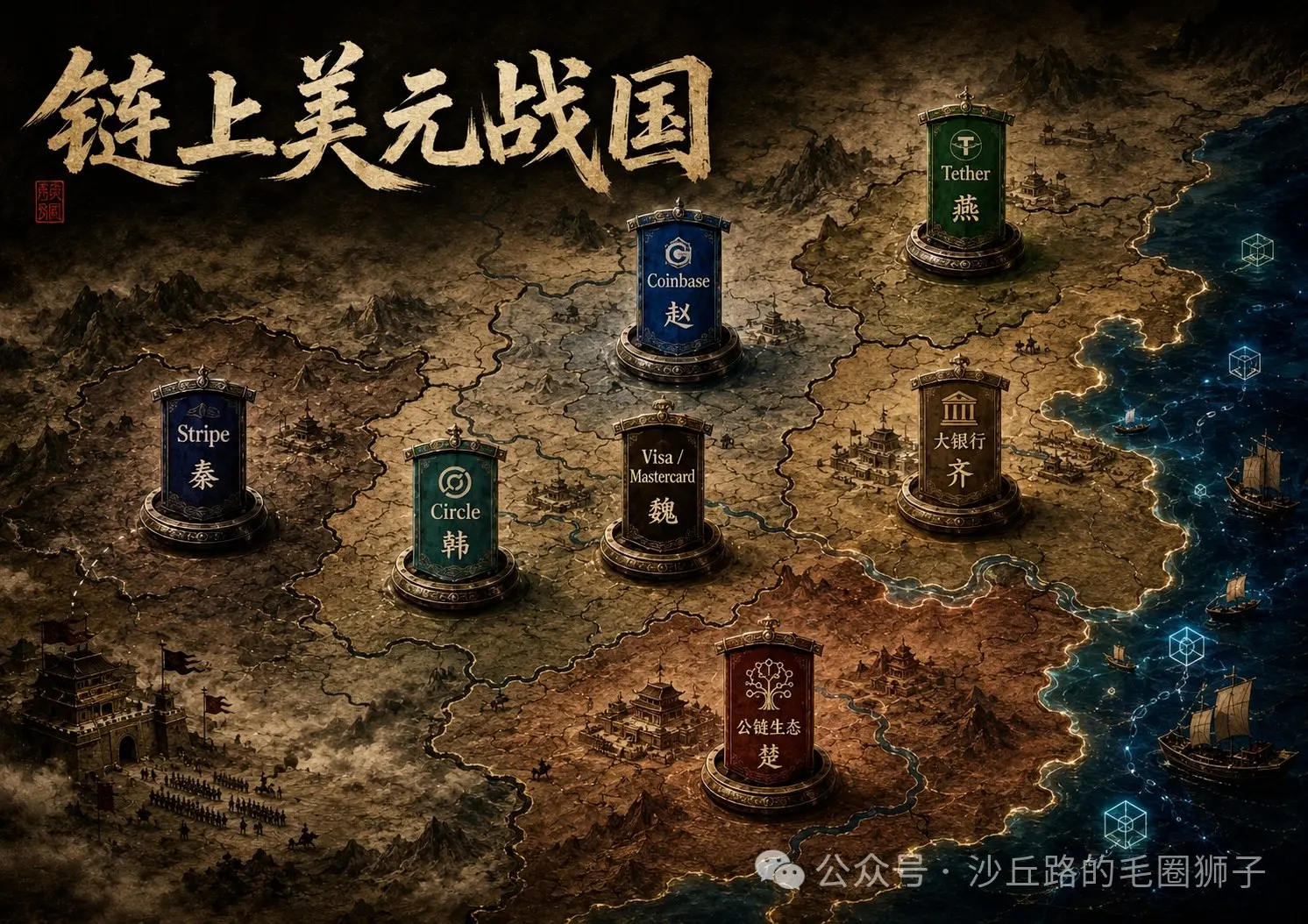
So, prima facie, these are the two official declarations that the stabilization and banking camps have finally drawn the Chu River border。
But the more I think about it over the weekend, the more I think it's not Truhan. At the end of the race for Chuhan there were only Liu Bang and Feng Yu, and none of them represented all interests on this table。
Visa and Mastercard are at peace with Cao and fear not to open a bank, but to be bypassed by the next generation, the settlement player。
Stripe and Coinbase appear to be in the same open stable currency camp, but a money movement that wants to take down businesses and businesses, a wallet, mobility and chain executive。
Coinbase and Circle are not equal allies, and Coinbase has been in a stronger position in the distribution and economic division of USDC。
JP Morgan had a chained deposit infrastructure and had to pull other large banks and package his pre-emptive advantage into common banking standards。
And from the outside, Tether doesn't want to be in China at all, and Etherum, Solana, Base, BNB, Tron, these chains are not part of traditional financial protocol。
It's more like a war country。
On the surface, there is a two-army confrontation, which is truly a seven-nation coup. Everyone is allied, and everyone is defending their allies。
It is not because the six nations love each other, but because everyone does not want to be eaten first。
Who's Qin? I think Stripe's most like Qin。
It's not because it's the biggest thing in the world right now, but it's like redefinition of the system in engineering, productization, API。
The true horror of the Qin is not a battle, but a county, military power, law, grain, measure。
Stripe's playing the same way. It does not have to issue the largest stabilization currency of its own, but it wants to define how an enterprise issues currency, how it collects, how it settles, how it manages its balance, how it handles its handling, how it connects to the global payment lock。
The point of Stripe's acquisition of Bridge is not just to buy a stockcoin infra, but to turn it into a Stripe-type capacity。
It's very straightforward for Bridge's Open Insurance: businesses can control their mint, burn, stock and product experience。
The threat to this type of issuer lies not in a new currency, but in the fact that the issue of a “stabilized currency” itself is beginning to be commercialized: once the distribution capacity becomes API, the real value is not coin, but distribution, communication, liquidity, mechant relationship and routing。
The end of Stripe may not be the largest assuer, but rather the operating system between all the assuer and the enterprise: you can send your own coin, use USDC, use USDT, connect to banks tokenized deposit, walk by card, walk by ACH, walk by Base or Solana, but the entrance, reconciliation, wind control, compliance, commercial relations and developer experience are best left here in Stripe。
The Qin nation is united, and measures are uniform. Stripe does stablecoin, first consolidates the interface。
Visa and Mastercard are more like Wei。
Wei is a traditional Chinese power, with a mature system, an important geographical location and strong early reforms, but in the middle of the war, the worst fear lies in being caught between old and new forces。
Visa and Mastercard are now in this position, where they master the core of the world's past payments, access network, hair-card banking relations, wind rules, dispute resolution and brand trust, but also know best that if they bypass the card network directly, they will be downgraded from “pay network rule-makers” to “an optional interface”。
So Visa/Mastercard won't really betray the bank. They have to do with bank cards, accounts, KYC, credit and regulatory relationships. But they cannot just stand behind the banks。
Visa has extended the stablecoin settlement pilot to nine chains, including Base, Polygon, Canton Network, Arc, Tempo, and already existing Etherum, Solana, Avalanche, Stellar; Mastercard has also continued to advance on the acquisition of stablecoin capabilities and related infrastructure。
this suggests that their strategy is not to pledge a single stable currency or a single chain, but to convert both the stable currency and the chain into a settlement option。
For Visa/Mastercard, the most important is not the card, nor the piece of plastic, but rather acceptance, rules, the risk allocation and the routing power。
As long as transactions are accepted, authorized, liquidated, pursued, refunded and complied with, they are valuable。
In other words, Visa/Mastercard doesn't want to be the dinosaurs in the world, they want to be the roads and gates in the world。
Big banks like Qi。
The country is rich, commercially developed and resource-rich, but the cost of internal coordination is high。
the banking system has the deepest deposit pool, the strongest regulatory relationship, and the core business traasury clients, but it is also the most vulnerable to their own institutional inertia。
They can't be re-engineered as light as Stripe, and they can't be out of mainstream regulation in the United States like Tether。
Their advantages are trust and balance sheets, and their disadvantages are trust and balance sheets。
the underlying objective of the banking union is not to stop stablecoin, but to stop stablecoin from turning the bank’s core deposit relationship into a part of another’s growing wheel。
this is why the regulatory boundaries of rewards/yield are so crucial。
if a consumer or an enterprise simply uses stablecoin to make cross-border payments, the bank can also say that this is a payment race。
But if the user has permanently placed the cash that was in the bank in the stockcoin balance because of the incentives of Coinbase, Stripe Wallet, Mercant Wallet or some other incentive, then the bank is no longer faced with a reduction in the cost of payment, but with a rewritten liability。
Coinbase is Zhao。
The Zhao State-owned cavalry, which is highly mobile, has long been between the centre and the border。
Coinbase has the advantage not of a single currency, but of mobility: exchange liquidity, Wallet, Base, industrial custody, developer ecsystem, U.S. compliance identity, and common user perception of crypto's access。
It can bind to Circe, it can work with Stripe/Visa/ Mastercard; it can eat the proceeds of USDC, it can develop Coinbase Business; it can use Base as a portal for chain applications, and it can use it as a gatewayx 402this kind of agreement leads to an agreement。
And Coinbase's participation in the new Stable Currency Alliance is not "tray against Circle."。
The relationship between Coinbase and Circle has never been a hand-in-hand between two completely equal allies. Circle and Coinbase entered the Collapse Agreement in 2023, and Circe will pay Coinbase the costs of its roles in USDC distribution and eccentric growth。
In accordance with the mutual agreement, Coinbase retains 100% interest income from USDC on the Coinbase platform, while off-platform and DeFi eco-based USDC revenues are divided into 50/50 by Circle。
Coinbase has veto rights in the new USDC-related partnership, the initial duration of the agreement until August 2026, which is automatically renewed unless the breach or the parties jointly decide not to renew the contract。
So Coinbase is not a temporary change of heart. It was originally a powerful distribution party in the USDC economic structure。
That explains why Coinbase must multi-home。
USDC is important to it, but Coinbase's end is not a channel for Circe, but an entrance to the United States dollar in the chain。
In the future, whether it be USDC, PYUSD, RLUSD, a Stripe-issued stablecoin, a bank deposit token, or mechant coin, Coinbase wants to be part of mobility, wallets, chain execution and developer ecology。
Circe is like Korea。
Korea is not insignificant, but its geographical location is too dangerous to be caught between powerful countries, and it hurts to be cut by either side。
The problem with Circle is not that USDC is not growing; on the contrary, USDC remains one of the world’s most important United States dollar-stable currencies, and it is Circe itself actively pushing USDC to exchanges, clearing houses, banks, neobanks, payment companies, and chains。
USDC supports 20 block chains, including Etheleum, Solana, Base, Arbitrum, Avalanche, Polygon, Stellar, Sui, etc., and also relies on Coinbase, Binance, Kraken, OKX and markets for distribution。
But that is the problem。
Circe seems to be in the middle of the stage, but its core capabilities are being dismantled:Distribution capacity is marketed by Stripe/Bridge, distribution is controlled by Coinbase, compliance narratives are absorbed by banks, settlement is ploughed by Visa/Mastercard, chain execution is divided by Base, Solana, EthelumI don't know。
USDC can continue to grow, but it is not necessarily possible for Circe to capture a profit pool that matches growth。
So Circe has to move from assuer to network. It cannot only prove that USDC is the most compliant, transparent and institutionally appropriate stability currency, but also that it has a distribution independent of Coinbase, a deeper distribution, more original use scenes for banks and payment companies, its own CPN and its stable currency network capability。
Otherwise, it becomes a high-quality option in someone's menu, not the menu itself。
Tether like Yan。
Far from China, Yan often does not live at the centre of ceremonial law and therefore has its own space。
Tether does not need to rush into the US’s mainstream finance mix, because its advantages come precisely from outside China: offshore dollar demand, the global South, exchange liquidity, low-cost paths such as the capital-control market, and Tron/BNB, as well as sufficiently deep path dependence。
The clearer United States supervision, the better for USDC, banks tokenized deposit and compliance, the better for institutions and for America。
BUT IN MANY BANKS THAT ARE INEFFICIENT, THAT ARE SHORT OF DOLLARS, THAT HAVE A HIGH DEGREE OF OVERSIGHT ASH, AND THAT USERS ARE ONLY CONCERNED ABOUT QUICK ACCESS TO THE DIGITAL DOLLAR MARKET, USDT STILL HAS ITS OWN STRENGTH。
Tether ' s strategy is not to enter the border (it can be seen as a collaborative test with the Trump government), but to continue to collect taxes。
IT'S ABOUT WHO'S GOT USDT IN THEIR WALLET。
And finally, Chu, which is the common chain ecology。
Communal chain ecology is not marginal. It is more like Chu: Culturally, it does not belong to the Chinese law of courtesy, but it is vast, complex, resourceful and not fully integrated, but it cannot be ignored by anyone who wants to unite the world。
Etheleum, Solana, BNB, Tron, Polygon, Canton, even Base, Tempo, Arc, who have in-laws with other great powers, are notCultural centres in traditional financePart of it。
They have their own languages, developers, wallets, Gas, MEV, Validator, Sequencer, Bridge, DEX, DeFi and community culture。
Look at them, and the people of Chu look at them。
banks and card organizations want to turn the chain into an embroilable settlement ranil, but the chain is not just a ranil. the chain has its own application layer, asset network and liquidity gravity。
Etherum wants to be an institutional asset and tokenize settlement。
Solana wants to be a high-frequency, low-cost, consumer payment and anticipatory transit highway。
Base wants to eat Coinbase distribution, USDC mobility and U.S. compliance user portal。
BNB and Tron continue to eat global South, exchange and USDT flows。
Canton, Tempo, Arc and the payment-orientated chain attempt to translate Chu culture into a system language that is acceptable to China。
Stripe wants a unified interface, but it's impossible to have all the scenes。
Visa/Mastercard tried to keep the rules network, but couldn't stop all the new rails。
banks want to hold deposits, but businesses and angent will require faster and more flexible financial flows。
Coinbase wants to be a dollar entry on the chain, but it's impossible to own all the business scenes。
Circe wanted to move from assuer to a network, but had to move away from a single distribution。
Tether continues to collect taxes outside the closed, but does not necessarily have access to the institutional compliance scene。
The common chain is as vast as Chu, but there is a need to translate its language to China。
That's the whole thing。
In the short term, both coalitions will reinforce their narratives。
the stabilisation currency coalition will say that it represents open networks, global payments, development and anticipatory company。
the banking union would say that it represents security, supervision, deposits, businesses, and system stability。
Both sides will continue to pull around CLARITY Act ' s border between rewards/yield, as this line determines whether the line is paid acceptance or deposit substitute。
In the medium term, the two alliances will begin to connect。
Visa/Mastercard supports both banks and a variety of stablecoin。
Stripe will be connected to banks, chains, assuer and businesses。
Coinbase will continue to benefit from USDC while promoting Base, Coinbase Business and x402。
Circe will try to get away from a single distribution dependency and move itself from assuer to a network。
big banks can criticize stablecoin rewards while accessing stablecoin demand。
The chain moves from a TVL contest to a standcoin fight。
In the long run, markets will not be unified into a single currency or a single chain。
business probably used tokenized deposits and tokenized money market funds。
Platforms payout, agentic company, API payment may use stationcoin rails。
USDT continues to be used extensively for offshore dollar and exchange liquidity. Institutional settlements and tokenized networks favour networks that are more easily interpreted for compliance。
HF consumption, agent calls and low-cost transactions leave room for Solana, Base, BNB, Polygon, etc。
The final winner is not necessarily the one who issues the largest stabilization currency。
Distribution rights will be commodified, chains will be crowded, wallets will be brokered and compliance will be agreed。
Real taxes, not in currency, flow from one system to another for each value。
That's why Visa expands the chain at the same timeAdyenAWS, American Express, Base, Circle, Cloudflare, Coinbase, Google, MasterCard, Microsoft, Polygon, Shopify, Sierra, Solana, Stripe, Thirdweb and Visa。
it shows that the seven countries have to sit in the same arena on the new standards of ghost payment and agency。
Agentic company is only the first level. It speaks of ant buying for people, ordering services, calling API, paying for reading, purchasing data, completing checkout。
At a deeper level, it is about managing money for people and businesses: deciding which rail to pay, when to exchange money, when to redeem money, when to replace USDC with deposit token, when to leave card, when to leave stockcoin, when to manually approve and when to implement it automatically。
Traditional payment systems are designed for people。
People will open apps, enter card numbers, point checkout, do 3DS, accept subscriptions, handle invoice, look at bank statements。
but angent should not be forced to mimic the human web page。
The target functions of Agent are cost, speed, success rate, compliance, recoverable, refundable, auditable, programmable。
it's not natural to be loyal to a chain, a sosser, a bank, a card network. it only chooses the best path under given policy。
that's why the end of stablecoin is not just paying, it's routing。
without it, the stable currency war rate would have been absorbed by the old payment system。
Consumers may have no idea they're using stablecoin, merchants only know that the money comes in faster, Stripe, Visa, Mastercard, PayPal, banks wrapping down the bottom settlement rail into the original product experience. The stabilization currency will become a better backstage part。
but if it's established, stability is not just a means of payment, it's the language of settlement for the machine economy。
API calls, model calls, data purchases, advertising, supply chain procurement, cross-border payout, enterprise cash management, automated reimbursement, real-time taxation, tokenized asset allocation may require a value transfer that is more suitable for machine calls than card, ACH, wirre。
This is also a real opportunity for entrepreneurs。
Large countries compete for standards, small countries repair gates。
Many of the changes in the system that took place during the time of the war were not kings, but travellers, philosophies, transversalists, craftsmen, businessmen and military elites。
