♪ FROM THE BIG BLANCHE TO SAN FRANCISCO: THE EPISODES AND DIZZINESS
Genius, wealth and an unfinished party

What's that Smell in San Francisco?
Original by Spencer Yen
Original by Peggy, Block Beats
EDITOR: SAN FRANCISCO IS RETURNING TO THE CROSSROADS OF THE TECHNOLOGICAL REVOLUTION AND THE FINANCIAL BUBBLE. AI COMPANIES, RESEARCH LABORATORIES, VENTURE CAPITAL, OUTDOOR ADVERTISING AND A NETWORK OF STREET NEWS HAVE WORKED TOGETHER TO CREATE A HIGHLY CHARGED URBAN CLIMATE: PEOPLE ARE VALUED AND TAKEN FORWARD, PEOPLE ARE IMMERSED IN THE AGI'S END-OF-LIFE IMAGINATION, AND PEOPLE SEE THE TALENT OF THE MATHEMATICS COMPETITION AS AN ENTRY POINT FOR THE NEXT GENERATION OF EXCESS RETURNS。
The author went into "I smell money" in "The Big Empty" and recorded his observations after moving from New York to San Francisco: the technological density, wealth creation and information asymmetries of this city are real, as is anxiety, comparison and Big Bubble Behavior. When AI became the only status game in San Francisco, innovation, speculation, faith and fear began to blend together, forming the most intuitive field sample of this round of AI heat。
The interesting thing about this article is not to rush to judge when bubbles break, but to present how bubbles happen: how people talk, compare, invest, worry, and how to find their place in the narrative of "the future is coming." The music is still ringing, the party is not over, but the author finally reminds himself and everyone in it: can dance, but not get drunk。
The following is the original text:
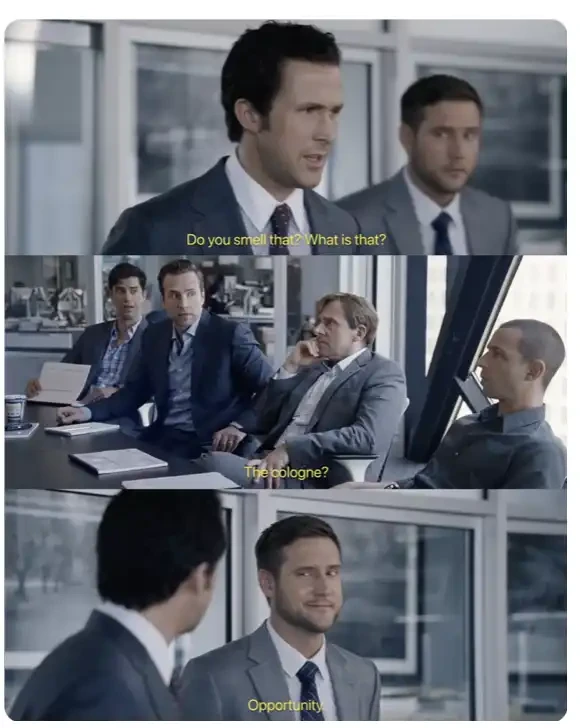
One of my favorite film scenes is that of Jenga in The Big Empty: Ryan Gosling's role as a playman for Steve Carroll's hedge fund team to sell empty United States real estate markets。
In that conference room, he had a sense of confidence in a jerk-off field with three props: His followers Chris, his quantification Jiang, and Jenga blocks with mortgage bond ratings. The opening remarks were also wonderful: do you smell them? What's that smell? What's that smell? No. Chance? No. It's money. I smell money。
https://www.youtube.com/watch?v=YgF98vyn2fY
A few months ago, I moved from New York to San Francisco to join a friend's start-up company. Before moving, they told me, "You must go to San Francisco," and said, "This is where it happened." So in the meantime, I've been facing a question: is San Francisco really that important? I was in New York. Did I really miss something
So far, my answer is: if you want to stay at the centre of this huge technological revolution and bubble, then this is where it should be. The density here is real, and so is the network of street news。
During this time in San Francisco, I have accumulated some observations and ideas. Here's what I smell in San Francisco:
People are shaking
2. There is only one status game here
Three, a city always shouting "The Wolf."
Four. The obsession with math genius
And what struck me was that in the same city, people can experience so much inversely -- - On some streets, you unfortunately feel like you're in hell; on another street you can see the bay, the trees and the beautiful view. The most technological and future-like moments here are probably watching auto-driving cars roam the streets of cities. Every time I see that kind of new, friendly light blue Wayne car, I can't help but laugh. Or you'll feel like you're being watched by Ava, this AI BDR. I hate that ad. But I have to say, they're using the anger bait to make me talk about it now. Every morning, when I left the apartment door, I saw this monster:
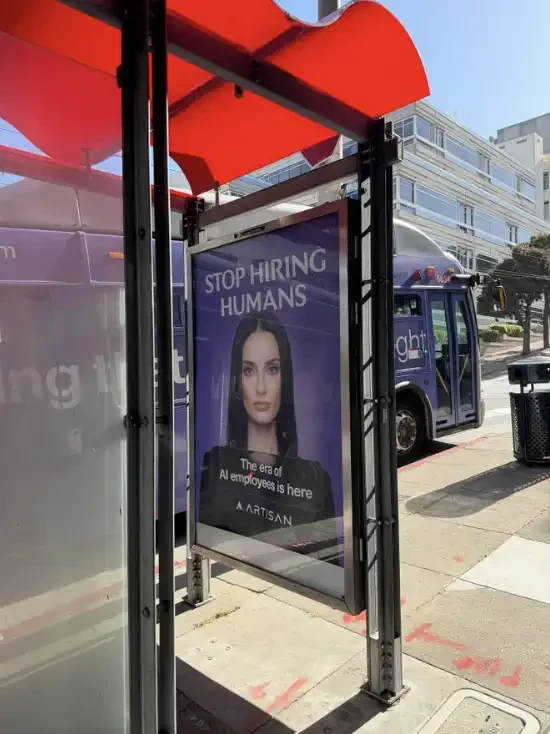
why do people do graffiti instead of graffiti and junk advertising? besides, if you live around here, we can go for ice cream
People are shaking in San Francisco
A few weeks ago, I played with my friend Jared. He lives in New York, but recently joined the Council. We had lunch and coffee at Cognition's office. Nice atmosphere, nice coffee, great roof. I asked him how he felt about San Francisco's vibe。
"Have you noticed that San Francisco people are shaking? * I laughed and thought, "What? And then I realized that I drank cold water in the morning and took 300 mg of caffeine, and now I'm shaking. "Yes, it's literally shaking. I'm not against the idea that you're trying to fill up the ADD, but you can keep an eye on the next time you meet someone -- see if they're shaking
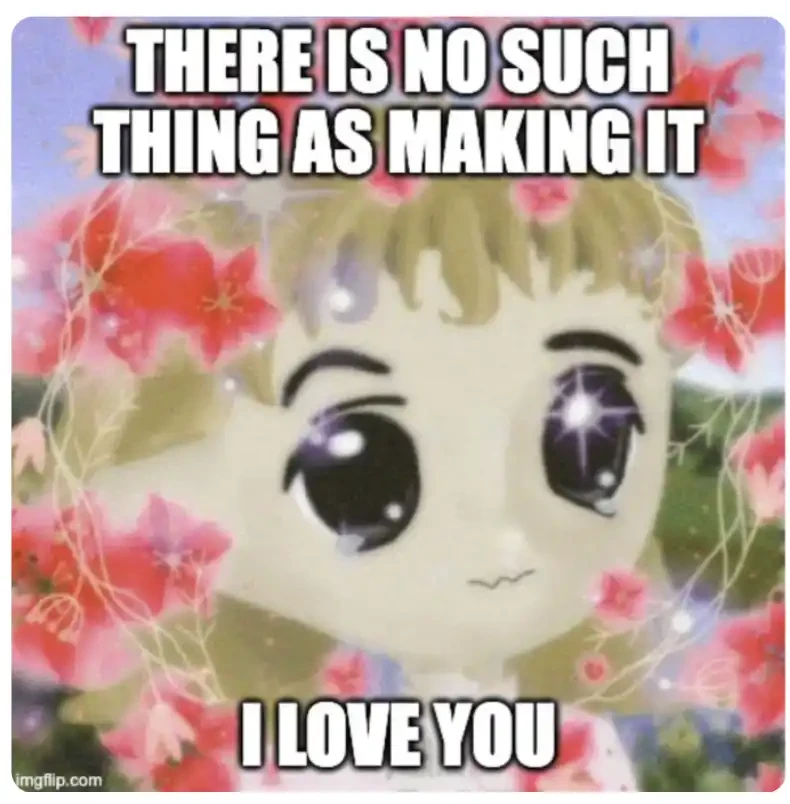
Foams and booms both bring a manic energy, as if there was no "make it" and no chance. And I can't be free -- Jared reminded me that I find myself shaking sometimes. The barrier of "scrambling, fleeing from the permanent bottom" has been corrupted, but it's more or less because it captures the mood of the times. If night life is the heartbeat of a city and the thermometer that defines its culture, what does it mean when the 24-hour café of a dog start-up company becomes a de facto night roll
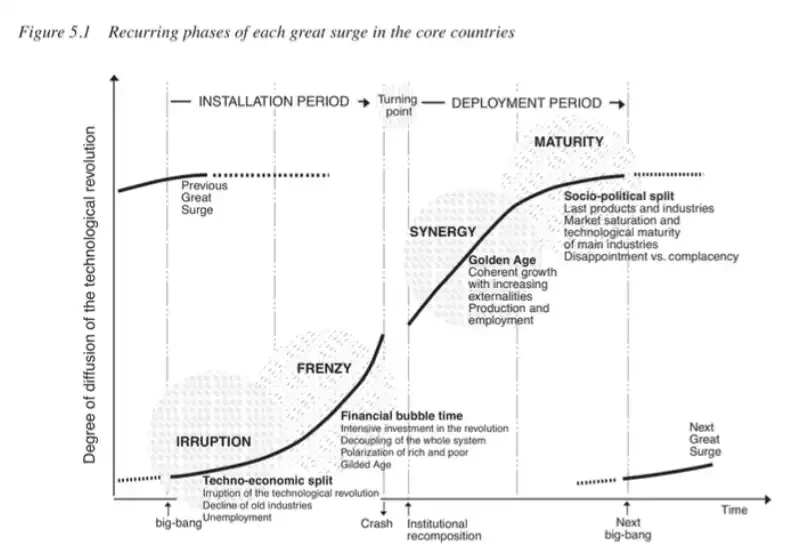
The shaking is part of the process of the technological revolution and the financial bubble. Next time I'm writing, I'll apologize if you want to kill me. But I was in Google Carlota Perez, trying to get some quotes back, and I liked Gemini's summary of the "Frenzie Phase":
Paradigm: The peak of the installation period, at which the market mentality has abandoned the fundamentals. Instead of seeking dividends, financial actors turned to capital gains, leading to the decoupling of the “paper economy” from the “real economy”。
source: https://stratechery.com/2021/the-death-and-birth-of-technology-reviews/
A friend of mine invented a word called Big Bubble Behavior. It's a beautiful saying, and I've been using it for the last two weeks to mark everything that fits the zeal phase. The market boom sometimes makes people do irrational things. Big Bubble Behavior. I've seen lobster tails twice in my life: first at an encrypted party in 2021 at a Venetian Island mansion in Miami, and second in 2026 at ClawCon。
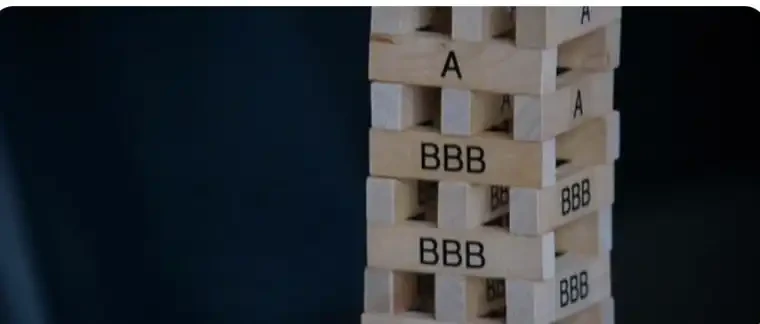
Big Bubble Behavior
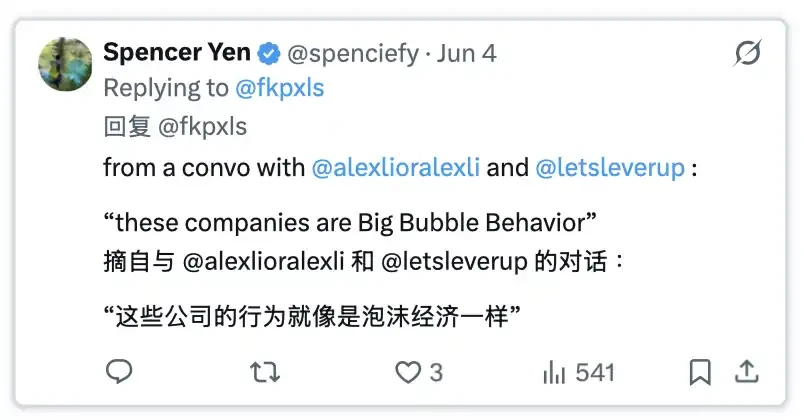
There's only one status game in San Francisco
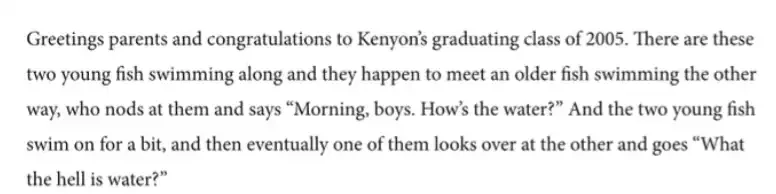
David Foster Wallace, This is Water: https://fs.blog/david-foster-wallace-this-is-water/
IN SAN FRANCISCO, THIS WATER IS AI. OUTDOOR ADVERTISING IS EVERYWHERE — BILLBOARDS, BUSES, BUS STOPS, SHARED BICYCLES, EVEN BLUE SKIES ARE OCCUPIED BY IT。
my problem with san francisco is that there's only one status game — technology. you go to dinner or hang out in the park, you hear the same words. and you'll see all kinds of "alpha farming" because those little news networks do exist. and i can't even be angry because i'm the same person myself. don't hate the player. you hate the game。
The problem is that when a city has only one dominant status game, you are too easy to compare with others。
We are increasingly measuring and comparing each other with some vanity indicators, such as how much money has been sequestered or what round your company has reached in the alphabet. I'd really like someone to get to Series Z, because that would just prove how ridiculous the private market is. You'll hear all kinds of gossip: which hot start-up companies are being pushed by financial players, and how hot their valuation is. And then you can't help but start doing that disgusting, Blind-style reverse math calculation: how much is somebody's equity bag worth now。
I told a friend that you'd be embarrassed to get to the toes if you saw the kind of reverse pay-out, optimization of the math on Blind. Blind is the big anonymous social network, the most famous one: "I'm in a life crisis and my wife may be leaving me, but do you think I should pick up Meta's L6 or Google's L9?" TC: $969 million. So why are we doing the same thing here now? Go out and touch the grass. Or, it's just what I'm using to comfort myself。
In New York, at least seven status games exist simultaneously. Finance, large law firms, music, fashion, celebrity circles, family offices, news, sports, entertainment. Because it's so wide, some games are so far away from reach that they make it interesting to talk and learn. It distracts all the ambitious people。
i enjoy asking my law school friends about the most prestigious top law firms, as well as understanding the delicate differences between each family; i enjoy learning the world of fashion and luxury goods and what it takes to survive in that industry; and i also enjoy learning about the good lives of quantitative elites and their arrangements for garden leaves。
San Francisco is creating unprecedented wealth, which brings a strange energy. A research friend mentioned that people around them were already studying to buy land and spread assets over scarce resources. There's a feeling that you're either a person who owns a laboratory or not. Another joke is that San Franciscoers do not know how to spend money; this strange energy comes from the creation of vast amounts of new wealth, but people do not know what to do with it. First time rich? Let experienced rich kids teach you how to enjoy life。
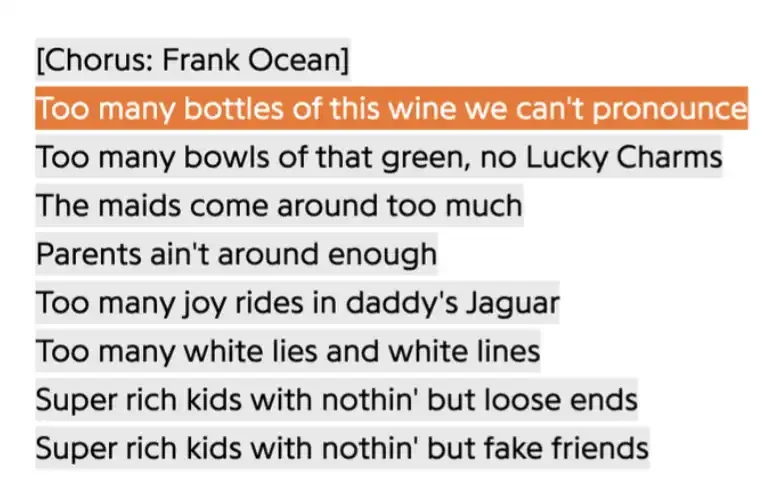
Super Rich Kids - Frank Ocean: https://www.youtube.com/watch?v=0XCQNpjWRE
A city always shouting "The Wolf"
My first feeling of San Francisco is an end-of-life sentiment. Perhaps the researchers in the lab really saw some kind of "second come," and if so, they would certainly be justified in calling for a slowdown and emphasizing safety. But I can't really know. The only thing I know is, how am I supposed to feel personally - not good
I've been through a lot of nihilistic conversations, and it's kind of like, "What are we doing here, if Mythos can take it all at once or blow it through?" And "Ai will ruin our lives?" and "Ai will create great inequality and cause great suffering to society."。
My saying here is that human beings always find something else to do, that jobs move to a higher level of abstraction, and that new things become valuable。
We're not very good at predicting the future of society. I think the anti-capitalists I read in college are actually going in the wrong direction -- imagine how they would react if they saw that humans could get happiness from the fruit garbage video produced by AI, or the "Tung Tung Tung Sahur" in Italian brain rot。
"THE PROBLEM IS NOT THAT AI MAKES CONTENT STUPID, [SNIFFS], BUT THAT WE ENJOY IT AS A SACRED PIECE OF GARBAGE, A DIGITAL OBJECT, [SNIFFS], DON'T WE?"
From my friend Samir. His resume is: not a researcher, but he has a Fish Boy。
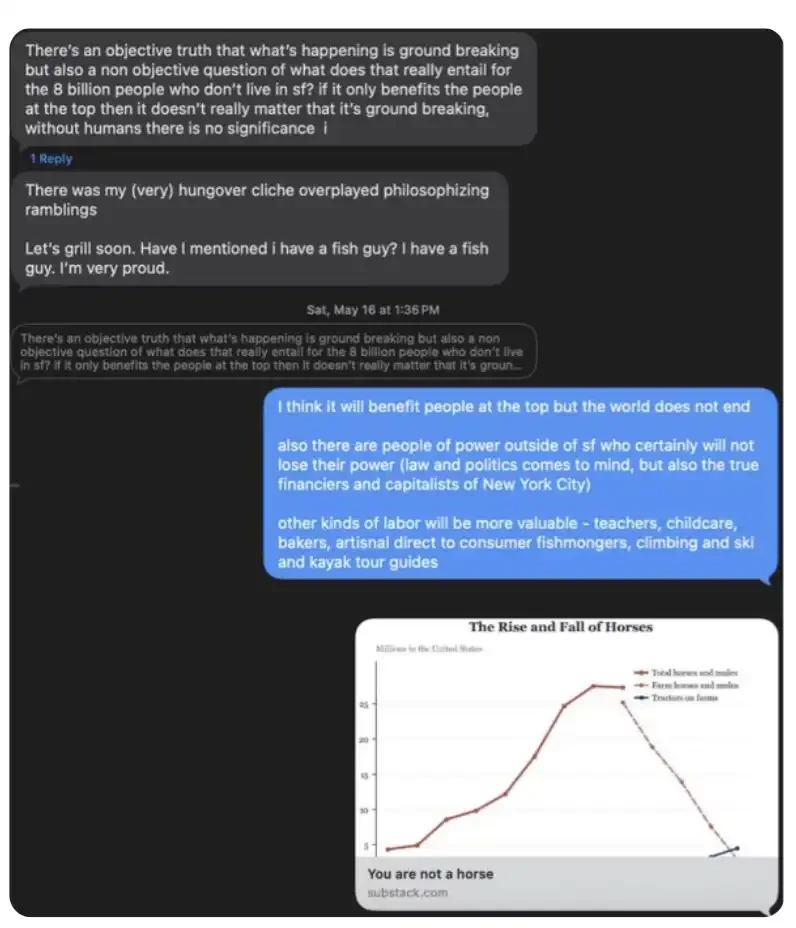
Does anyone else have their own brother? Please tell me。
A friend working in a laboratory pointed out that the GTM (market/sale/growth) team and the research team in the same company had a completely different life experience at the moment. That end-of-life theory will be balanced by something else: "Come play with the GTM team, have a beer, touch the grass." There is indeed something to wonder between the pessimism of model creators and the optimism of those closest to technology landing. It's time for Forward Deproyed
the reality has alarming numbers of details: https://johnsalvatier.org/blog/2017/reality-has-a-surprising-amount-of-detail
Six years ago, when I was in college, I wrote about AI's idea of reshaping the social fabric, entitled Polanyi and the Second Great Transport。
Let me explain this quote: Karl Polanyi, an economic sociologist of the Austrian Empire, is represented by The Great Transition. The book, written in 1944, criticized the rise of modern British market capitalism in the nineteenth century. So, the "first big transition" is a transition to capitalism, and I was 21 years old thinking I was smart and calling AI the "second big transition," you know。
The most famous concept in Polanyi is the "Dual Movement" which describes a historical push: on the one hand, the free market is expanding; on the other hand, society is counterproductive, trying to protect itself through regulation. The first major movement is the attempt by the capitalist elite to expand the free market and commercialize society; today it is the commodification of intelligence. The second major reverse movement is the reaction to market-driven destruction and the attempt to protect society; today, it is anti-AI, anti-data-centre rhetoric。
That's what I was, like, 21-year-old college kids wrote:
Polanyi explains that the development of machines for production has led to the “miscrution” of labour (people) and land (natural). Although the fourth industrial revolution had already taken place in a market system, the advent of mechanical wisdom posed a different threat: taking over. As computers are able to perform more "human" cognitive tasks more efficiently, many ordinary people may lose their jobs。
Polanyi writes: "Nothing can save the common people of England from the impact of the industrial revolution. Blind faith in spontaneous progress has taken hold of people's minds..."
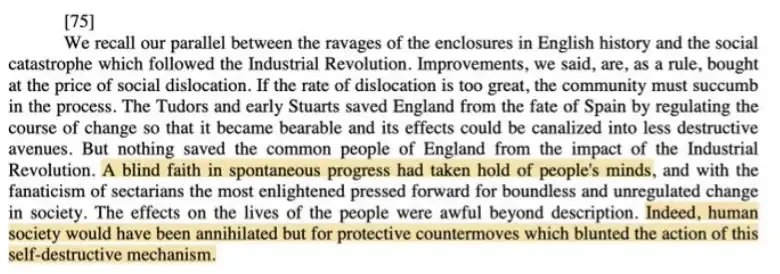
https://mediam.com/@spenceryen/polanyi-and-the-second-great-transformation-6d6364b5d3c6
So think about it now, maybe those who keep calling "wolves" are right. Blind faith in spontaneous progress does not necessarily yield good results. Polanyi criticized market capitalism in the sense that economic activity was subordinated to social, cultural and religious systems for much of human history. But later, market capitalism turned the relationship upside down and subordinated society to the economy。
How do we ensure that society does not belong to a country made up of geniuses in data centres? As Ben Thompson correctly pointed out in his article on Mythos on Anthropic, the joke of the story of Wolves is that the wolf really did come。
But what would the capitalist inside me think? So invest in social, cultural and religious systems. If you have any good trading ideas, you're welcome to give me your book。
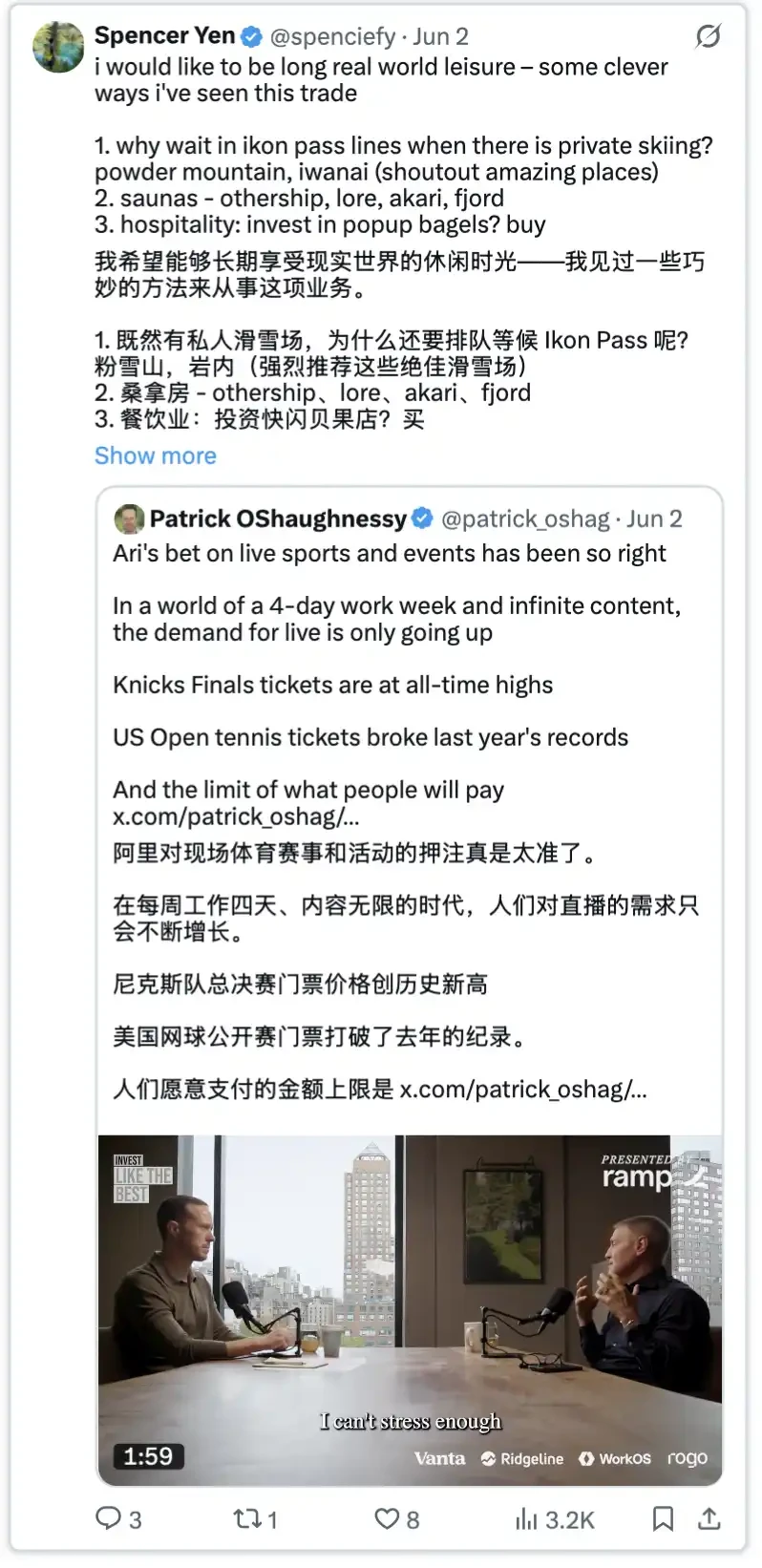
The obsession with math geniuses
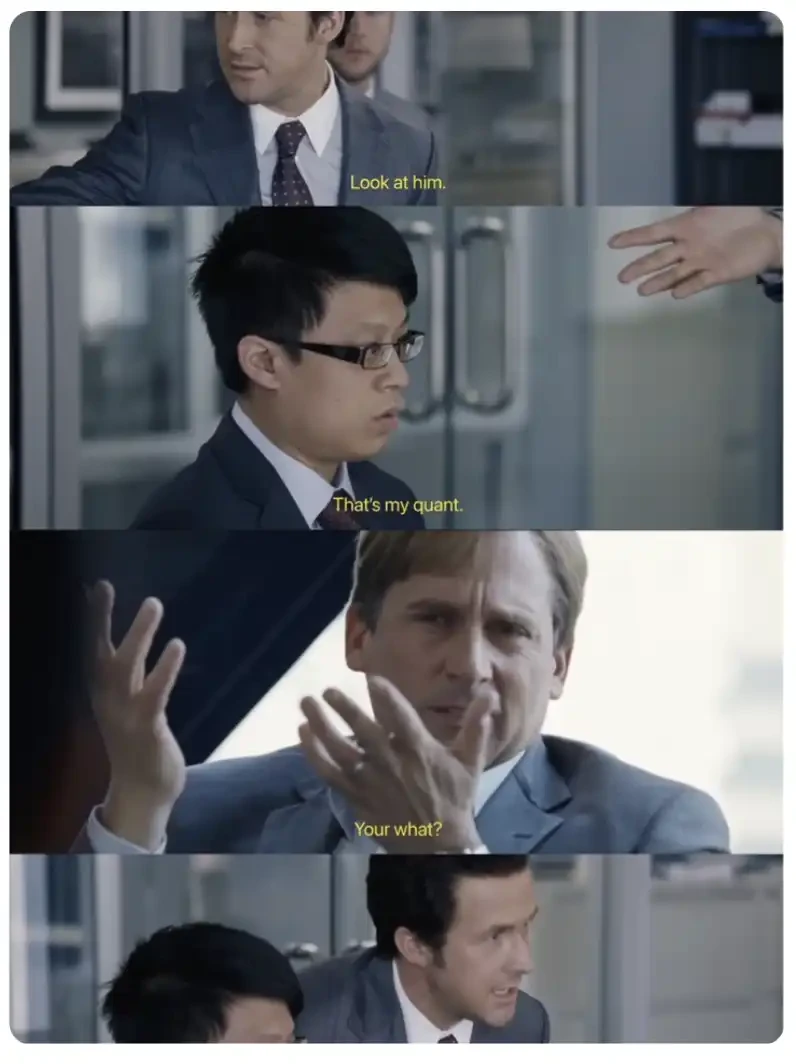
Another of my favorite obstacles in the Junga buildup scene was Ryan Gosling pointing at the Chinese man next to him and saying, "That's my quant." "This atmosphere has a strange resemblance to the most popular founders of this recent group of investors. - They're often genius kids killed in math competitions when they were kids。
Or Ryan Gosling, responding to Steve Carroll's question:
"You mean, as long as the default rate is 8%, the bonds fall, and now it's 4%? If they rise to 8%, it's the end of the world? Are you absolutely sure about this mathematical model?" "Look at him. That's my quantification. "Your what?" "My quan-ti-ta-tive, my math expert." Look at him. Did you not notice the difference between him? Look at his face." That's racist. "Look at his eyes. I'll give you a hint. His name is Yang. He won the National Math Competition in China. He can't even speak English. So I'm sure of this mathematical model."
In the eyes of some investors, the key predictive indicators of a fund, DPI (distributed to Paid-In Capital, ratio of allocated revenues to paid capital, often used to measure the real return of the fund), appear to come from the founding fathers' childhood-- - Either he was a math genius when he was a kid or he had some kind of childhood trauma. I grew up in the Bay District, and my knowledge of my math skills was damaged long ago, because all my talented classmates were mixed up in the math competition. Now, they're basically Quantified Traders or Fellows in Big Model Laboratories。
I was particularly aware of what happened in seventh grade: my dad and I went to the sports channel on my home TV, and I saw my junior high school classmate on ESPN2 and he went to Mathcounts Math. I knew at that moment that my path was over. I used to joke that when I started playing that "roll college application" game in ninth grade, I knew I couldn't compete with those Intel STS, RSI, Aime, USACO kids, so I had to find a set of rules for my own game。
I very much admire many such distinguished CEOs, founders and researchers, and I personally did bet one of them financially. But what makes me laugh is that today, around "bringing the smartest math contest kids and using them as extra payback tickets," a complete asset class and investor narrative has been created. Think about it, it's no different than the scout looking for the next Wemby. But I'd like to believe the story of Ellen Brunson -- hard work, hard work, hard work, hard work。
HyperliquidI don't know。
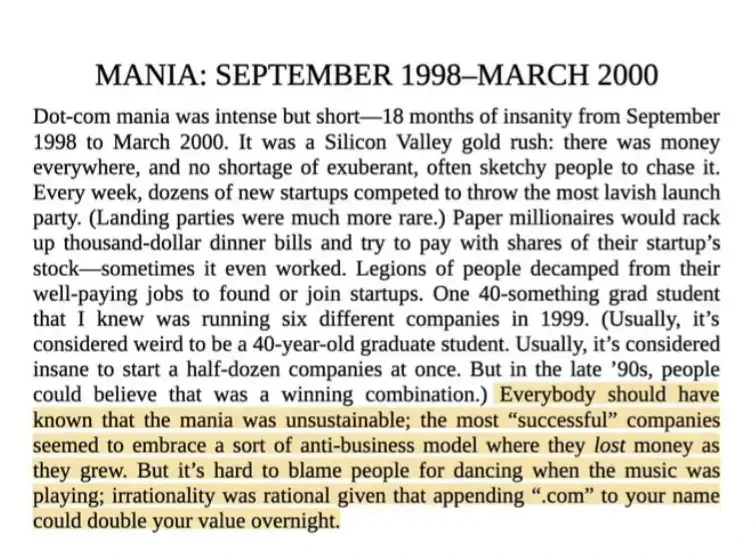
It's like a party in 1999
https://x.com/elonmusk/status/166326406618619910
An intelligent investor gave me two suggestions:
First, you'll experience three bubbles in your life。
The first time you go through a bubble, you'll be completely in the ecstasy. You're inexperienced, you're at a party, you're caught in a frenzy。
When you went through the bubble for the second time, you remembered what happened the first time, so you could walk away with some victory, but you'd get involved。
The third bubble is your chance to create intergenerational wealth. - You've gained enough experience in the past two years to manage risks, emotions and exit times。
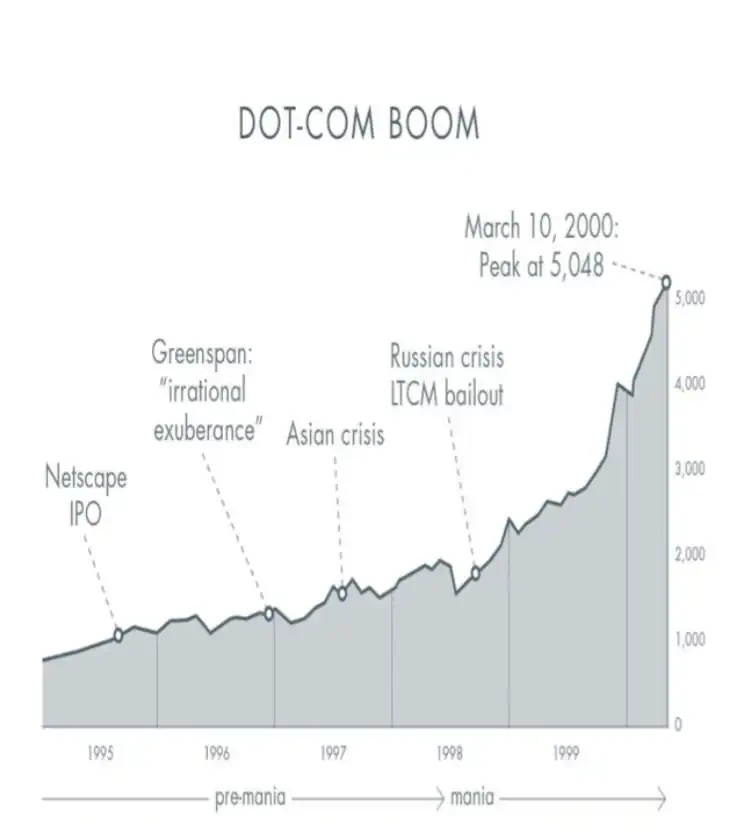
The second is to dance when the music rings, but not get drunk。
The music is now deafening, and it may even damage the sound. But the larger back-up sound is being created and the party is obviously not over。
It's for me and for everyone who needs to hear this: touch the grass, cook for yourself, and don't let Big Bubble Behavior distort your judgment. To borrow the wise words of my friend Samir: let's start a barbecue together as soon as possible. Do you know anyone who sells fish
From Peter Thiel from 0 to 1
