
Hwang In-hoon's latest podcast full copy: The Future of Inweida, Smart and Agent Development, Episode Demand and Artificial Intelligence Public Relations Crisis
THE COMPETITION FOR THE FUTURE IS NOT JUST GREATER THAN WHO'S MODELING, BETTER CALCULATING, BUT ALSO WHO KNOWS THE INDUSTRY, WHO CAN EMBED AI DEEPER INTO REAL PROCESSES, WHO CAN ORGANIZE THESE CAPABILITIES INTO A FUNCTIONING, SCALABLE SYSTEM
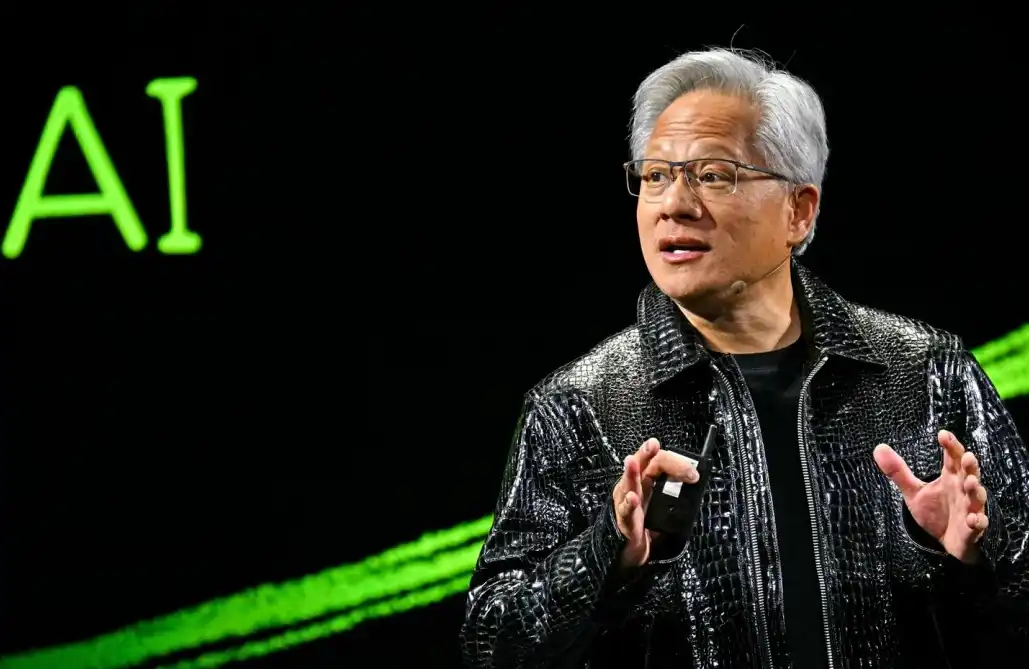
Video title: Jensen Huang: Nvidia's Future, Philippine AI, Risk of the Agent, Reference Exchange, AI PR Crisis
Image by All-In Podcast
Photo by Peggy Block Beats
THE EDITOR PRESSES THAT, IN THE CURRENT HEAT OF THE AI NARRATIVE, THE FOCUS OF THE MARKET DISCUSSION IS MOVING FROM "HOW STRONG THE MODEL" TO "HOW THE SYSTEM LANDED." OVER THE PAST TWO YEARS, THE INDUSTRY HAS EXPERIENCED SUCCESSIVE BREAKTHROUGHS IN LARGE-SCALE MODELLING CAPABILITIES, TRAINING-CALCULATIONS COMPETITIONS AND EXPANSION OF GENERATING APPLICATIONS. BUT WHEN THESE STAGES BECOME CONSENSUS, NEW QUESTIONS EMERGE: WHEN AI NO LONGER SIMPLY ANSWERS QUESTIONS, IT BEGINS TO PERFORM TASKS, EMBEDS BUSINESS PROCESSES, ENTERS THE PHYSICAL WORLD AND SUSTAINS ITS PROGRESS AT THE BOTTOM
All-In Podcast. As one of the most influential investors in Silicon Valley, the programme was co-chaired by four long-active front-line investors and was well known for the in-depth discussion of science and technology, business and macroeconomic trends。
The four presenters were:
Jason CalacanisEarly Internet entrepreneurs and angel investors are well known for investing in Uber, Robinhood and others
Chamath PalihapitiyaSocial Capital, former Facebook executive, has invested in a number of technology companies such as Slack and Box
David SacksCraft Ventures, a member of the PayPal Gang, founded Yammer and sold it to Microsoft for approximately $1.2 billion, as well as early investors from Airbnb, Uber
David FriedbergThe Project Board, founder, focused on investment in agriculture, climate and life sciences, was founded by the Climate Corporation (subsequently acquired by Monsanto)。
The current guest is Jensen Huang, co-founder and CEO of NVIDIA, and is considered one of the most critical drivers of the current AI infrastructure wave。
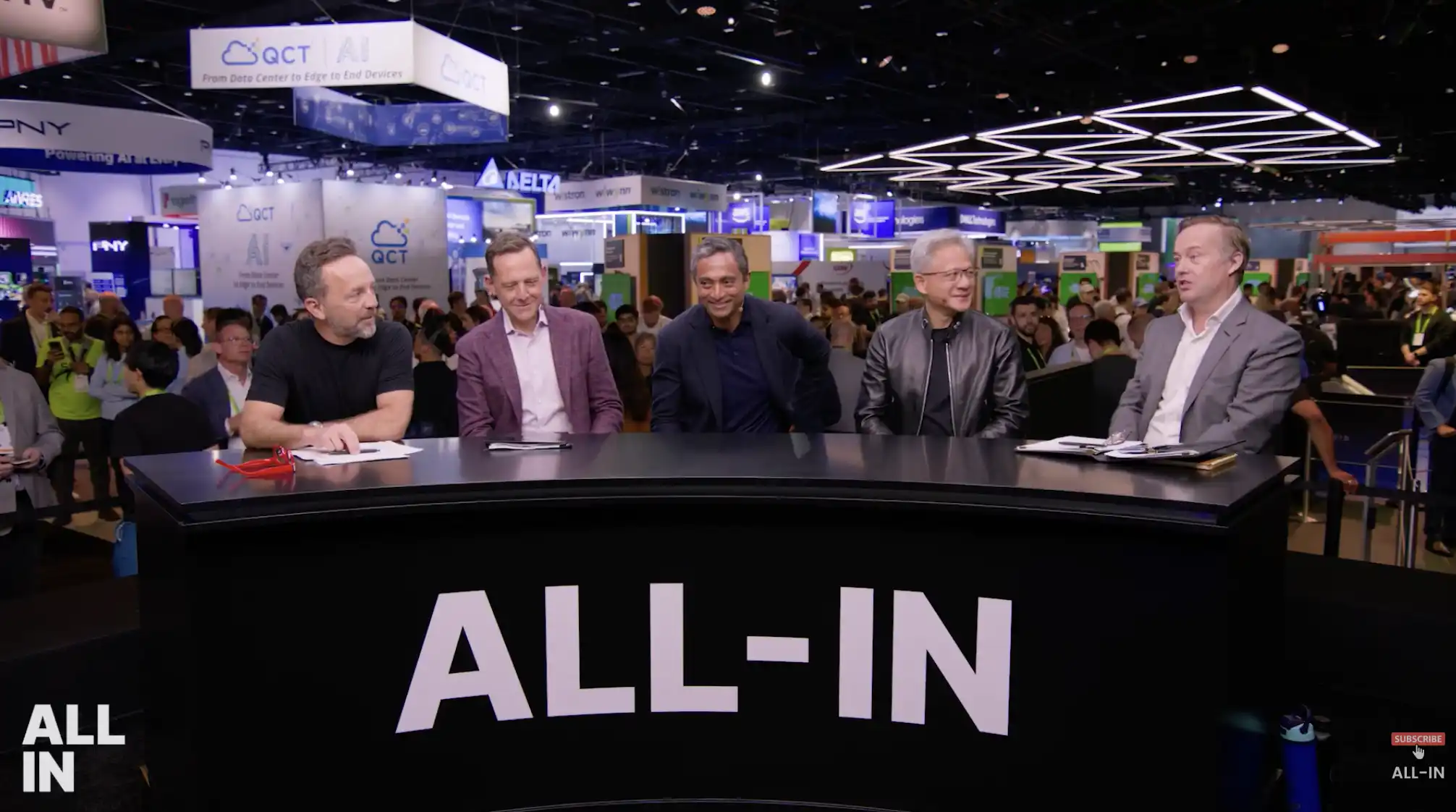
From left to right are David Friedberg, Chamath Palihapitiya, David Sacks, Jensen Huang, Jason Calacanis
The entire interview can be broadly summarized at three levels。
FIRST OF ALL, THE INFRASTRUCTURE OF AI IS CHANGING。In the past, the market ' s understanding of AI was largely based on a stronger GPU, more data centres. However, Huang In-hoon would like to emphasize that future competition is no longer just a competition for a single chip, but a competition for an entire system. As the demand for reasoning rises, the variety of models increases, and angent begins to deal with more complex tasks, AI calculations are moving from a relatively single model in the past to a more complex and divided system collaboration. As a result, NVIDIA tried to move its role further from a chip company to the builders of the "AI Factory"。
SECOND, AI IS MOVING FROM "GENERATED CONTENT" TO "MISSION."。This is the most critical clue in this interview. ChatGPT allows the public to visualize AI's ability for the first time, but, from Wong In-hoon's point of view, the real change is that AI is beginning to enter the workflow in the form of ant: it is not just answering questions, it is able to call tools, dismantle tasks, work together, and finally finish things. This is why users are willing to pay for AI and move from "get an answer" to "get a result." Behind this is a greater need for reasoning, greater complexity of systems, and the possibility that software development, organizational management and knowledge work may be rewritten accordingly。
FINALLY, AI IS EXTENDING FROM DIGITAL TO REAL。In interviews, neither automatic driving, robotics, medical, digital biology, nor Physical AI in the mouth of Hoang In, are essentially pointing to the same trend: the value of AI is not only on screen, but increasingly in factories, hospitals, cars, terminal equipment and everyday life. But this also means that AI will no longer be faced with technical challenges, but will also include more complex realities such as supply chains, policies, regulation, manufacturing capacity and geopolitics. In other words, the next round of AI expansion will be a truly industrial process。
FROM THIS POINT OF VIEW, WHAT IS MOST INTERESTING ABOUT THIS CONVERSATION IS NOT A PARTICULAR PRODUCT, OR AN OPTIMISTIC NUMBER, BUT A REPEATED JUDGEMENT FROM HUANG IN-HOON: AI IS MOVING FROM A "MODEL AGE" TO A "SYSTEMIC AGE." THE COMPETITION FOR THE FUTURE IS NOT JUST BIGGER AND MORE CALCULATOR THAN WHO KNOWS THE INDUSTRY, WHO CAN EMBED AI DEEPER INTO REAL PROCESSES, WHO CAN ORGANIZE THESE CAPABILITIES INTO A FUNCTIONING, SCALABLE SYSTEM。
IT ALSO MAKES THE SUBJECT OF THIS PAPER GO BEYOND NVIDIA ITSELF. THE REAL QUESTION IT'S TRYING TO ANSWER IS, WHEN AI BECOMES INFRASTRUCTURE, HOW WILL THE NEXT ROUND OF INDUSTRIAL RESTRUCTURING UNFOLD, AND WHERE WILL THE NEW VALUES BE FORMED。
The following is the original text (in order to facilitate reading and understanding, the original text has been consolidated):
TL;DR
• AI INFRASTRUCTURE IS MOVING FROM A “SINGLE GPU” TO A DECOUPLING STRUCTURE。Different computational tasks will be carried out with the collaboration of GPU, CPU, web chip and Groq。
NVIDIA IS MOVING FROM A GPU TO AN "AI PLANT COMPANY" THAT PROVIDES A COMPLETE SYSTEM。It's an infrastructure package, not a single chip。
The key to measuring AI costs is not data centre pricing, but token costs and absorb efficiency。More expensive systems might be cheaper。
AI is moving from a generation model to the Age of Age。Users are really willing to pay for "doing things" instead of just getting answers。
• Calculating demand is booming。from generation to reasoning to angent, it may have expanded more than 10,000 times in a short time and is accelerating。
Future software development will change。engineers no longer write codes, but define problems, design structures, and collaborate with angent。
• In the long run, the greatest opportunity lies in the deep specialization of vertical areas rather than in the generic model itself。Whoever knows the industry, who knows the moat。
Other Organiser
Jason Calacanis (known angel investor All-In Podcast host Uber):
THIS WEEK IS A SPECIAL. WE GIVE THE WEEKLY ROUTINE "LEAVE OUT", WHICH WE USUALLY GIVE TO ONLY THREE PEOPLE: PRESIDENT TRUMP, JESUS, AND WONG IN-HOON. AS FOR HOW THESE THREE SHOULD BE LINED UP, IT'S UP TO YOU. YOU'VE BEEN WORKING TOO HARD LATELY, AND THIS TIME GTC HAS BEEN VERY SUCCESSFUL。
Jensen Huaang, CEDO:
THE WHOLE INDUSTRY IS HERE. ALL TECHNOLOGY COMPANIES, ALL AI COMPANIES ARE ALMOST THERE。
Jason Calacanis:
It's incredible. It's really extraordinary. One of the most significant launches in the past year was Groq. When you acquired Groq, did you realize how "unsufferable" Chamath would be
Note: Groq is not Grok. The former is an AI reason chip and a cloud of reasoning, while the latter is a XAI chat robot. Towards the end of 2025, Groq and NVIDIA entered into a non-exclusive technical authorization agreement, with no official disclosure of the amount of the transaction; however, there were reports and speculations about $17 billion to $20 billion. By GTC 2026, Huang In-hoon further demonstrated the reasoning system based on Groq technology integration into the NVIDIA platform。
Chamath, referred to here, refers to Chamath Palihapitiya. He was both one of the four facilitators of All-In and one of the early investors and board members of Groq. Thus, when NVIDIA and Groq's major deal surfaced, it was also considered that Chamath was again in the key project。
Wong In-hoon:
I'm hiding something。
Jason Calacanis:
We have to deal with him every week。
Wong In-hoon:
I know. And you will be with him for a full six weeks。
Jason Calacanis:
Exactly。
FROM GPU TO "AI FACTORY"
Wong In-hoon:
Actually, many of our strategies will be publicly available on GTC years ahead of schedule. Two and a half years ago, I introduced to the operating system of the AI factory called Dynamo。
And you know, Dynamo was originally a device, invented by Siemens, that could transform water energy into electricity and boost the factory system in the last industrial revolution. So I think that's a very good name for the next industrial revolution. And in Dynamo, one of the core techniques is decomposition of decomposition。
Jason Calacanis:
Jensen, I know you know a lot about technology. Come on, you define it. I don't want to rob you。
Wong In-hoon:
Thank you. So-called decorative reasoning means that the whole treatment of the line is extremely complex and may even be the most complex type of calculation today。
IT'S AMAZING IN SCALE, AND IT CONTAINS A LOT OF MATHEMATICAL CALCULATIONS OF DIFFERENT FORMS AND SCALES. THE IDEA IS TO UNTANGLE THE WHOLE PROCESS SO THAT ONE OF THEM RUNS ON ONE CLASS OF GPU AND THE OTHER ON ANOTHER. FURTHER, IT REMINDS US THAT PERHAPS DECOMPOSITION IS ITSELF A REASONABLE DIRECTION: WE CAN WELL BRING TOGETHER THE DIFFERENT TYPES AND TYPES OF COMPUTING RESOURCES。
The same idea led us to Mellanox. You see today, NVIDIA calculations are already spread over GPU, CPU, switch, vertical extension switch, horizontal extension switch and network processor. Now, we're gonna put Groq in。
OUR GOAL IS TO PUT THE RIGHT LOAD ON THE RIGHT CHIP. IN OTHER WORDS, WE HAVE EVOLVED FROM A GPU COMPANY TO AN AI FACTORY COMPANY。
David Sacks (PayPal COO|All-In)
THIS IS PROBABLY THE MOST IMPORTANT INSPIRATION FOR ME. WHAT YOU'RE SEEING NOW IS A FUNDAMENTAL "DEMARCATION." THERE USED TO BE ONLY GPU, AND NOW THERE ARE MORE AND MORE DIFFERENT FORMS OF COMPUTATION, AND THESE CHOICES WILL COEXIST IN THE FUTURE。
You mentioned on the stage that I think all those who do high-value reasoning should listen carefully: you said about 25 percent of the space in the data centre should be allocated to Groq's LPU。
Note: LPU is an abbreviation for Language Processing Unit. This is a chip class proposed by Groq. Core positioning is not training, but reasoning
Wong In-hoon:
Yeah, in the data centre, it's probably possible to get Groq to about 25% of the Vera Rubin system。
Note: Vera Rubin is the next generation AI platform architecture for NVIDIA. It is not a single chip, but a system-level infrastructure platform for the AI plant。
David Sacks:
can you tell me how the industry looks at this direction? in essence, you're building the next generation's decomposition structure: prefil, decode, and the reasoning process is split. how do you think everyone will react
Wong In-hoon:
Take a step back. We were adding this capability to the system because the entire industry had moved from a big-language model to an agency processing, which is a smart body-style process。
When you run an agent, it accesss work memories, long-term memories, calls tools, which are very stressful for storage. You'll see angent working with angent. Some agents use mega-models, some are small models; some are diffusion models, and some are self-return models. That is to say, within this data centre, there will be a variety of completely different models at the same time. We built Vera Rubin to deal with this extremely diverse load。
SO, WE USED TO BE A COMPANY WITH ONE SHELF, AND NOW WE HAVE FOUR MORE. IN OTHER WORDS, NVIDIA'S TAM, THE SERVICEABLE MARKET, EXPANDED AT ONCE, ABOUT 33% TO 50% HIGHER。
And the additional 33% to 50% of this is going to be a large part of the storage processor, Bluefield; part of it, I personally hope, will be a large part, a Groq processor; part of it will be a CPU; of course, there will be a lot of network processors. All of this, taken together, is finally running the "new computer" in the AI revolution, which is agents. It is the operating system of modern industry。
Chamath Palihapitiya (Social Capital founder former Facebook executive All-In host):
WHAT ABOUT EMBEDDED APPLICATIONS? LIKE THE TEDDY BEAR AT MY DAUGHTER'S HOUSE, WHAT'S IN IT IF HE WANTS TO TALK TO HER? OR IS THERE A BROADER TAM IN THE FUTURE IN THE MARGINS AND EMBEDDED SCENES, WITH DIFFERENT SCENARIOS WITH DIFFERENT TOOLS
Note: ASIC refers to Application-Specific Integraded Cituit, TAM refers to Total Servicesable Market
Wong In-hoon:
We think there are actually three computers in this problem。
THE FIRST ONE, ON THE LARGEST SCALE, IS THE COMPUTER USED TO TRAIN AI MODELS, DEVELOP AI, AND CREATE AI。
The second is the computer used to evaluate AI. Look around, for example. There's robots, cars. You have to put them in a virtual environment that represents the physical world. In other words, the software itself has to follow the laws of physics. We call this system Omniverse。
The third is a computer deployed on the edge, a robotic computer. It can be an auto-drive, or a robot, or even a little teddy bear。
FOR A TEDDY BEAR, ONE OF THE VERY IMPORTANT DIRECTIONS IS WHAT WE'RE DOING: MAKE THE TELECOMMUNICATIONS BASE PART OF THE AI INFRASTRUCTURE. SO THE ENTIRE $2 TRILLION-SCALE TELECOMMUNICATIONS INDUSTRY WILL GRADUALLY BECOME AN EXTENSION OF AI INFRASTRUCTURE. THUS, RADIO EQUIPMENT BECOMES PERIPHERAL, FACTORIES BECOME PERIPHERAL, AND WAREHOUSES DO THE SAME。
In short, all three types of basic computers are essential。
David Friedberg (Moderator of All-In Podcast, founder of The Production Board):
Jensen, last year I thought you saw it before the world. You said that the reasoned demand would not grow just 1,000 times。
Wong In-hoon:
Did I blow myself up
David Friedberg:
It's going to grow a million times? A billion times
I think many people at the time thought it was an exaggeration because the world was staring at the training expansion. But now, you see, the reasoning has really broken out and it's starting to be "restricted." Now you've published another "workshop of reasoning" that will swallow up 10 times more than the next generation。
BUT IF YOU LOOK AT THE OUTSIDE WORLD, A LOT OF PEOPLE WOULD SAY, "YOUR REASONING FACTORY IS GOING TO COST 40-50 BILLION DOLLARS, AND THOSE ALTERNATIVES, LIKE CUSTOMIZED ASC, AMD, AND SO ON, JUST $25-30 BILLION, YOU'RE GOING TO LOSE MARKET SHARE。
So why don't you just tell us what you saw? What do you think of market share? Are these customers worth nearly double the premium
why do more expensive systems produce cheaper ones
Wong In-hoon:
the most important and central point is that the price of the plant should not be the same as the price of the token, nor the cost of the token。
it's possible, and i can prove, that the $50 billion factory actually produces the least expensive token. the reason is that we generate these tokens so efficiently, 10 times more。
YOU SEE, THE DIFFERENCE BETWEEN $50 BILLION AND $20 BILLION IS ACTUALLY JUST LAND, ELECTRICITY AND PLANT HOUSING. BESIDES, YOU'RE SUPPOSED TO BUY STORAGE, NETWORK, CPU, SERVERS, HEAT-DISPERSION SYSTEMS. SO THE GPU ITSELF IS THE ORIGINAL PRICE OR THE HALF PRICE, AND IT DOESN'T BRING THE TOTAL COST DOWN FROM 50 BILLION TO 30 BILLION. YOU JUST TAKE A NUMBER YOU LIKE, A LITTLE MORE REALISTIC, MAYBE JUST DOWN FROM $50 BILLION TO $40 BILLION。
And if a $50 billion data centre is 10 times higher, then the difference is nothing。
Jason Calacanis: Got it。
Wong In-hoon:
And that's why I keep saying, even for a lot of chips, if you can't keep up with the technology front and the speed at which we move, it's not cheap enough。
David Sacks:
I would like to ask a more macro-strategic question. You're running the world's most valuable company. Revenues could exceed $350 billion next year, free cash flows could be $200 billion, and they were growing at a crazy rate。
How do you make decisions? How do you get information? Everyone now knows your well-known mail system, but how do you really form intuition, shape markets, decide where to focus, where to contract, where to enter new fields? How did this information get to you? What are you gonna do about it
Wong In-hoon:
THAT'S THE CEO'S JOB。
David Sacks:
Right。
Wong In-hoon:
It is our duty to define visions and strategies. Of course, we will draw inspiration and information from the outstanding computer scientists, technologists and countless good employees in the company, but ultimately it is our duty to shape the future。
A part of the test is: is it too difficult? If it's not hard enough, we should stay away from it. The reason is simple: if one thing is easy to do, there will be plenty of competitors。
Is it something that no one has ever done and it's too difficult? Does it happen to mobilize the "superpower" unique to our company? So I have to look for a crossroads where it has to meet these criteria at the same time。
And finally, you have to know that doing this must be accompanied by considerable pain and suffering. There is no great invention because it is too simple and easy to succeed for the first time。
If one thing is super hard and no one has ever done it, it basically means that you are going through a lot of pain and suffering. So you better enjoy the process。
David Sacks:
CAN YOU PICK THREE OR FOUR MORE "LONG TAILS" FOR BUSINESS? YOU'RE TALKING ABOUT DATA CENTERS IN SPACE, ADAS AND CARS, AND BIOLOGICAL DIRECTIONS. GIVE US A SENSE: WHEN WILL THESE CURVES START TURNING UP? WHAT DO YOU THINK OF THESE LONG-TERM OPERATIONS
Note: ADAS refers to the Advanced Driver Assistance Systems
Wong In-hoon:
Sure. Physical AI is a large category. As I said earlier, we have three computing systems and all the software platforms on them. Physical AI is the first real opportunity for the technology industry to serve a 50 trillion dollar-sized industry that was barely technically adapted in the past. In order to do this, we must re-create all the technology needed。
I always thought it was a 10-year journey. We started 10 years ago, and now we finally see it turning up. For us, this is already a multi-billion-dollar business, and it is now close to $10 billion a year. So it's already a big business, and it's growing exponentially. That is the first point。
Second direction, I think in digital biology, we've really been very close to its ChatGPT moment。
We are gradually learning how to express and understand genes, proteins, cells. Chemical matter, we already know how to handle it. So the basic components of biology and their dynamic behaviour can be expressed and understood, and I think this will happen in about two to three to five years. Within five years, I am very confident that digital biology will have a huge impact on the whole health industry。
These are very important directions. Agriculture is also one of them。
Chamath Palihapitiya:
It's already happening。
Wong In-hoon:
No doubt about it。
Jason Calacanis:
I want to pull the topic back from the data centre to the desktop. Early companies were largely based on lovers, game players and graphic card users. When you were on stage today, in front of about 10,000 people, you talked about the revolution brought by Claude Code, OpenClaw and delegate。
In particular, we see that a great deal of energy and innovation is actually going on with them, and that many breakthroughs occur on the desktop. You also released a desktop device this time. I remember Dell 60800? It's a very powerful workstation that runs local models and has 750 GB memory. Now Mac Studio's out of sales everywhere. Our company is now completely turning to OpenClaw. Friedberg was in use, Chamath was in use, and everybody was obsessed。
what does this open-source movement, desktop-end open-source ecology, starting with lovers, mean to you? where does it go
Agent's age: Why does the need to calculate expand 10,000 times
Wong In-hoon:
First, look back. In the last two years, we have actually seen three turning points。
The first time is generated AI. ChatGPT takes AI into public view and makes everyone aware of its importance. Actually, this technology was clearly there months before ChatGPT appeared. It's only when ChatGPT puts in an interface that everyone can use to generate AI。
And generation AI, as you know, generates token for both internal and external consumption. Internal consumption is essentially "thinking," which furthers the development of reasoning。
Then, more and more ground-based, information-based capabilities began to emerge, so AI could not just answer questions, but rather provide more reliable and useful answers. You're starting to see an upturn in OpenAI's income and business patterns。
And then the third point, which was actually only visible within the industry, was Claude Code. It's the first truly useful agentic system, extremely revolutionary。
But before Claude Code, it was mainly directed at businesses, and many outsiders never saw it. Until OpenClaw brings "What the hell can I do?" to public view。
So the importance of OpenClaw at the cultural level is that, for the first time, it truly makes the public aware of the ability of an individual。
The second reason why it matters is because OpenClaw is open。
More importantly, it has created a completely new computing model, almost re-engineering the calculations themselves. It has a memory system: scratch is short-term memory, a file system is long-term resource; it has dispatch capability; it can run a cron job; it can generate new agents; it can decipher tasks, cause reasoning, solve problems; it also has an I/O subsystem that can enter, export, connect to whatsApp; and it has an API that can run different kinds of applications, the so-called skills。
And these four elements essentially define a computer. So, for the first time, we actually have an artificial computer。
And it's open, really open, can run almost anywhere. This is the blueprint of modern calculations. In a sense, it is already a modern computing operating system and will be everywhere in the future。
of course, we have to help it solve one thing: as long as you have the agentic software, it can get access to sensitive information, enforcement codes, external communications. so we have to make sure that all of this is governed, that it is safe enough, that it is strategically constrained, that these agents have two of three capabilities, but not all three at the same time。
We have also made a contribution in the area of governance. Peter Steinberger was there today. We have a lot of great engineers working with him to help make the system safer and more robust, so that it can protect both privacy and security。
Chamath Palihapitiya:
Jensen, has this paradigm shift made many of the AI regulatory acts passed across the United States seem obsolete
MANY OF THE PROPOSALS WERE ORIGINALLY BASED ON OLD MODELS. WOULD YOU LIKE TO TALK ABOUT HOW FAST THIS PARADIGM IS CHANGING TO INVALIDATE A WHOLE RANGE OF OLD REGULATORY THINKING? NOW AI REGULATION HAS BECOME A VERY POPULAR TOPIC IN AMERICAN POLITICS。
Wong In-hoon:
This part of us must always be ahead of policymakers, and you have done very well in that regard. We must come to them and tell them what stage of technological development is, what it is, not what it is. It's not living, it's not alien, it's unconscious. It's computer software。
Also, we often hear the phrase "we don't understand this technology at all." But that's not true. We've actually understood a lot. So first, we must provide policymakers with real information on a continuous basis; let not endurance and extremism dictate the way in which this technology is understood。
BUT AT THE SAME TIME, WE HAVE TO RECOGNIZE THAT TECHNOLOGICAL DEVELOPMENT IS FAST AND THAT POLICIES SHOULD NOT GO TOO FAR THAN TECHNOLOGY. AT THE NATIONAL LEVEL, MY GREATEST CONCERN IS THAT AMERICA’S GREATEST NATIONAL SECURITY RISK TO AI IS NOT AI ITSELF, BUT THAT OTHER COUNTRIES ARE ADOPTING AI, AND THAT WE ARE RELUCTANT TO EMBRACE AI FOR ANGER, FEAR, OR BIGOTRY。
SO WHAT REALLY WORRIES ME MOST IS THAT AI IS NOT SPREADING FAST ENOUGH IN AMERICA。
David Sacks:
Ask again. What would you think if you sat in the board room and watched them and the War Department? And that's what you've just said: people don't know how to understand AI, and there's an additional layer of resentment, fear and mistrust. If it were you, would you suggest that Dario and his team do something different to change today's results and public awareness
Wong In-hoon:
First of all, Anthropic's technology is amazing. We're an important user of Anthropic technology. I greatly admire the importance that they attach to security, as well as their commitment to a security culture and their technical excellence in advancing these efforts。
Moreover, they want to remind the public of the limits of the capabilities of this technology, which I believe is good in itself. It is only important to realize that the world has a spectra: caution is a good thing, it's not so good to scare people。
Jason Calacanis: Yeah。
Wong In-hoon: Because this technology is too important to us. I think it is certainly possible to predict the future, but we need to be more cautious and more modest. Because, in fact, we cannot predict the future completely。
If some very extreme and disastrous judgements were to be cast, and there was no evidence that those things were actually going to happen, the harm might be greater than thought。
And now we're leading the technology industry. Nobody listened to us before, but it's different now. Technology is deeply embedded in the social fabric, an industry of great importance and highly relevant to national security. Every word we say matters。
So I think we must be more cautious, more restrained, more balanced and more thinking。
David Friedberg:
I'LL NOMINATE YOU FOR THIS. AI HAS ONLY 17% PUBLIC OPINION IN THE UNITED STATES. WE HAVE SEEN WHAT IS HAPPENING IN THE FIELD OF NUCLEAR ENERGY: WE BASICALLY SHUT DOWN THE ENTIRE NUCLEAR INDUSTRY, AND NOW CHINA IS BUILDING 100 FISSION REACTORS, NONE IN THE UNITED STATES. NOW WE'RE STARTING TO HEAR A PAUSE IN THE DATA CENTRE OR SOMETHING. SO I THINK WE HAVE TO BE MORE PROACTIVE。
But I'd like to go back to what you're saying is happening inside the company: efficiency, productivity. There's a lot of argument going on. When you and I entered this year, the biggest question was: Will income come? Will income expand like intelligence itself? And then we saw something a little bit like Oppenheimer: Anthropic earned $5 billion, $6 billion a month in February alone。
Note: "Oppenheimer Time" comes from Oppenheimer, head of the Manhattan Project (Secret Research Project to Develop Atomic Bombs during World War II). In 1945, the atomic bomb detonated for the first time, symbolizing the threshold at which technological breakthroughs coexisted with risks, and is now mostly used to point to critical technological moments with irreversible effects。
What do you think's going on? And you're saying today that Blackwell and Vera Rubin are already on the order of trillions of dollars in demand in the coming years. Plus the momentum that Anthropic and OpenAI are showing, do you think we're on that curve and then we'll see income expand as fast as intelligence
Wong In-hoon:
I'll answer from a few angles. Look at this audience, Anthropic and OpenAI are really here. But in fact, 99 percent of what was present was AI, not Anthropic, not OpenAI. The reason behind this is that AI itself is extremely diverse。
I would say, as a category, the second popular model is actually an open model. The first is, of course, OpenAI, open source weights, open source models, an entire category of open ecology. The second is open models, and there is a wide gap with the third. Third place is Anthropic。
THIS SHOWS HOW BIG ALL OF THE AI COMPANIES TOGETHER ARE, SO FIRST OF ALL, TO REALIZE THIS。
When we move from the generated AI to the reasoning, the number of calculations needed is about 100 times higher; when we move from the reasoning to anatomy, the number of calculations is likely to increase another 100 times. In other words, in just two years, the calculated demand has increased roughly 10,000 times. At the same time, people pay for information, but what they are really more willing to pay is actually the result of work。
David Friedberg: Yeah。
Wong In-hoon:
talk to chat robots, get an answer, of course. it's great to do research for me. but what really makes me want to pay is that it's helping me do it. and that's where we're at right now, and the agency system is really doing it. they're helping our software engineers finish the job。
So you think, on the one hand, 10,000 times more calculations, on the other, probably 100 times more consumption needs. And we have not even really begun to expand on a large scale. We're definitely on the road to a million times the growth。
Jason Calacanis:
I think that could lead to a question. How many people are in your company
Wong In-hoon:
We have 43,000 employees, about 38,000 engineers。
Jason Calacanis:
we often talk about a topic in podcasts: god, the use of token in our company is growing crazy. some even ask how much token quota i can get when i join a company because they want to be efficient employees. i remember you talking about that two-and-a-half-hour game in keynote, which was really long, but great。
Wong In-hoon:
Thank you. It could have been shorter。
Jason Calacanis:
You mentioned that token for every engineer could cost $75,000 or so. Does that mean that the NVIDIA engineering team spends 1 billion, 2 billion dollars a year on token
Wong In-hoon:
WE THOUGHT SO. I'LL GIVE YOU AN IDEA EXPERIMENT: ASSUMING YOU HIRED A SOFTWARE ENGINEER OR AN AI RESEARCHER WITH AN ANNUAL SALARY OF $500,000, WHICH IS COMMON HERE。
By the end of the year, I asked him, "How much did you spend on token this year?" If he said, "$5,000," I'd just blow it up, really. I'd be very alert if an engineer with an annual salary of $500,000 spent a year on token worth less than $250,000. It's the same thing as the chip designer says, "I decided to use only paper and pencils, and I don't need CAD tools."。
Jason Calacanis:
It's really a paradigm shift. Your understanding of these top employees almost reminds me of LeBron James in MBA class: he spends $1 million a year on his body, so he can still fight at 41. Why shouldn't these top intellectuals have superhuman powers
Wong In-hoon:
Exactly。
Jason Calacanis:
IF WE PUSH THIS TREND BACK TWO OR THREE YEARS, WHAT WOULD THE EFFICIENCY OF THESE TOP EMPLOYEES IN NVIDIA BE? WHAT CAN THEY DO
Wong In-hoon:
First of all, the idea of "this is too hard" disappears. "This is going to take too long," and it disappears. "We need a lot of people," and it disappears。
It's like in the last industrial revolution, no one would say, "This building looks too heavy. And no one will say, "That mountain is too big. All ideas about "too big, too heavy, too time-consuming" will be eliminated。
David Sacks:
The last thing left was creativity. What can you think of。
Wong In-hoon:
exactly. in other words, the question of the future will be: how do you work with these parties。
In essence, it's just a completely new way of programming. In the past, we write codes, and in the future we write ideas, structures and specifications; we organize teams; we define evaluation criteria and tell the system what's good, what's bad, what's good; we're going to repeat it, what's good, what's good, what's good, what's good, what's good; we're going to repeat it, what's bad, what's good。
that's what you really want to do. i believe every engineer will have 100 angents in the future。
Jason Calacanis:
Go back to PR. Entrepreneurs like David Friedberg, using your technology and AI in Ohalo, are really doing real things: boosting food production and improving quality calorie supplies. Friedberg, how much do you think this cost? How will this vision affect what you do
David Friedberg:
We just made a zero sample gene formation model, and it worked. You'd be really surprised at that moment. And this is happening in the context of "others replacing the entire business warehouse overnight."。
I did one thing myself: in 90 minutes, I replaced the entire stack and a whole lot of work. Sunday night starts at 10:00, all run and deploy by 11:30。
AS CEO, I ASKED ALL MY MANAGEMENT TEAM MEMBERS TO DO THE SAME EXERCISE ON WEEKENDS. BY MONDAY, WE SAW THE RESULT: IT'S OVER。
More technical, more scientific. We did one thing in 30 minutes with auto research and a collection of data. This would have been the product of a PhD-level paper if it had followed the traditional path, which could have taken seven years, or even become one of the most popular doctoral jobs in the field, enough to be published in Science。
We were just on a desktop, downloading auto research on GitHub, pouring in some of the data we just got, and we ran out in 30 minutes. Everyone's face changed. It unlocks the potential, really incredible。
So I think this acceleration is expanding the possibilities for everyone in an unprecedented way。
but go back to the auto research. one weekend, 600 lines of code can produce such results and can also run and process so many different types of data sets locally。
Does this mean that we are at an extremely early stage, whether it be algorithmic or hardware optimization
Wong In-hoon:
OpenClaw is so amazing, first of all, because it coincides perfectly with the break point of the big language model, and it appears too accurate。
And to a great extent, Peter probably wouldn't have made this thing if Claude, GPT and ChatGPT hadn't reached this level today. Because the model is really good enough。
Secondly, it brings with it new capabilities: to enable these models to access tools that we have created over the years. The browser, Excel; in the chip design, Sympsys and Cadence; Omniverse, Blender, Autodesk, etc. And these tools will continue to be used in the future。
Now some people say that the business of IT software is going to be destroyed. But I'm giving you another perspective: the size of the software industry, which used to be limited to "how many ass sits" -- that is, the number of seats. But in the future, it'll be 100 times more likely. These agents will knock on SQL, will knock on vector databases, will knock on Blender, Photoshop。
The reason is simple: first, these tools are already doing well; and second, they are essentially "intermediaries" between us and the machine. Eventually, when the work is done, the results must come back to me in a way I can control. And I know how to operate these tools。
So I want everything to end up going back to Synopsys, to Cadence, because that's where I can control it and verify it。
Note: Symps, Cadence are two important EDA software companies, all of which rely on them (NVIDIA, Apple, AMD)
AI'S NEXT FIELD: OPEN SOURCE, VERTICALIZATION AND GLOBAL SPREAD
David Sacks:
I want to ask an open source question. Now we have closed-source models, which are excellent; we have open weight models, many of which are amazing and really strong。
Two days ago, maybe you were busy on stage, and you didn't see it. They trained a 4 billion-pound Llama model in a distributed way. A random group of people contributed to the calculation, but they managed the entire training process in a state of standing. I think it's very technical, because the people involved are completely randomly dispersed。
Wong In-hoon:
It's like our age's Folding@home。
Note: Folding@home is a distributed computing project that allows global volunteers to contribute computer energy for protein simulation and medical research
David Sacks:
EXACTLY. SO WHAT DO YOU THINK OF THE END OF OPEN SOURCE? CAN YOU SEE THAT THE ARCHITECTURE IS ALSO BEING DECENTRALISED AND THE ALGORITHM IS BEING DECENTRALISED TO SUPPORT THE PATH OF OPEN WEIGHTS AND COMPLETELY OPEN SOURCES, THEREBY MAKING AI TRULY WIDELY AVAILABLE
Wong In-hoon:
I believe that we basically need two things at the same time: first, models as commercial products, proprietary products of first class citizens; and second, models as open-source forms。
THIS IS NOT A RELATIONSHIP BETWEEN A OR B, BUT BETWEEN A AND B. NO DOUBT ABOUT IT. THE REASON IS THAT THE MODEL IS FIRST A TECHNOLOGY AND NOT A FINAL PRODUCT. MODELS ARE A TECHNOLOGY, NOT A SERVICE。
And for most users, at that horizontal level, at the general intelligence level, I don't really want to go to fine-tune for myself. I prefer to continue with ChatGPT, Claude, Gemini, X. They're individual, depending on how I feel and what I want to solve. So this part of the industry will be well developed, and it will be very prosperous。
However, in all these industries, knowledge, professional competence in the field have to settle down in a way they can control, which can only come from open models. The open model industry is very close to the front line. We are also investing heavily。
Frankly, even if open models are at the forefront, I still believe that models -- services, world-class commercial product models -- will continue to flourish。
Jason Calacanis:
Almost every start-up company we're investing in now is opening up and moving to proprietary models。
Wong In-hoon:
Right. And the wonderful thing is, as long as you have a good router, on the first day, every day, you get the best model in the world. At the same time, it gives you time to downplay, fine-tune and specialize. So you started with world-class skills, and then slowly built your own moat。
David Friedberg:
Jensen, I want to ask you a geopolitical question. Of course, no one wants America to win the global AI competition more than you do. But a year ago, the Biden-era diffusion rule was actually preventing the spread of American AI technology across the globe。
THE NEW GOVERNMENT HAS BEEN IN POWER FOR A YEAR NOW. HOW MANY POINTS DO YOU GIVE IT? WHAT'S GOOD? WHAT'S BAD
Wong In-hoon:
First, President Trump wants US industry to lead, US science and technology to lead, US science and technology to win, US technology to spread globally, and US to be the richest country in the world. He all wanted to be realized。
BUT AT THIS POINT IN TIME, NVIDIA, THE SECOND LARGEST MARKET IN THE WORLD, HAS ALREADY LOST 95 PER CENT OF ITS ORIGINAL MARKET SHARE, WHICH IS NOW 0 PER CENT. PRESIDENT TRUMP WANTS US TO TAKE THIS BACK。
The first step is to obtain licences for companies that we can sell. Many companies have filed applications, we have applied for permits for them, and the Minister of Commerce Lutnick has approved some of them. We then informed the Chinese company that many of them had placed purchase orders on us. So we're restarting the supply chain and sending the goods。
ON A HIGHER LEVEL, I THINK WE SHOULD ADMIT ONE THING: OUR NATIONAL SECURITY IS WEAKENED WHEN WE DO NOT HAVE ACCESS TO MICROWIRES, RARE EARTH MINERALS; WHEN WE CANNOT CONTROL OUR COMMUNICATIONS NETWORKS; AND WHEN WE CANNOT PROVIDE SUSTAINABLE ENERGY FOR OUR COUNTRY. EVERY SINGLE ONE OF THESE INDUSTRIES IS A STORY I DON'T WANT AN AI INDUSTRY TO REPEAT。
AND WHEN WE LOOK TO THE FUTURE, AND ASK, "WHAT DOES THE U.S. TECHNOLOGY INDUSTRY, THE U.S. AI INDUSTRY REALLY LEAD THE WORLD?", WE HAVE TO BE HONEST: THE AI MODEL CAN'T BE EATEN ALL OVER THE WORLD BY THE U.S., AND IT DOESN'T MAKE SENSE。
BUT WE CAN ONLY IMAGINE THAT AMERICAN TECHNOLOGY VAULTS, FROM CHIPS TO COMPUTING SYSTEMS TO PLATFORMS, ARE WIDELY USED GLOBALLY. PEOPLE AROUND THE WORLD CAN BUILD THEIR OWN AI, PUBLIC AI, PRIVATE AI, TO SERVE THEIR SOCIETY. I WANT THE U.S. TECHNOLOGY WAREHOUSE TO COVER 90% OF THE WORLD. I REALLY HOPE SO。
Otherwise, if the final situation becomes like solar energy, rare soil, magnets, electrics, communications equipment, I would think that would be a very bad outcome for US national security。
Chamath Palihapitiya:
How closely do you focus on global conflict situations? How worried is that? The Middle East, for example, may affect the supply of helium, which is a potential supply chain risk for semiconductor manufacture. How worried are these problems? How much energy have you devoted to this
Note: Helium is important for semiconductor manufacture, which is difficult to replace not only in the critical links of light and detection, but also as a non-renewable resource, with a highly concentrated supply that relies mainly on a small number of sources such as the United States, Qatar (Middle East) and Algeria (North Africa). Once these upstream supplies are disturbed, they may have a direct impact on the steady operation of the chip production line。
Wong In-hoon:
First, speaking of the Middle East, we have 600 families there. There are many Iranian employees in the company, and their families are still in Iran. So we have a lot of families there。
The first thing: they're very anxious, very worried, very scared. We have been thinking about them and keeping an eye on the changing situation. They'll get 100% of our support. I was also asked whether, given the current situation in the Middle East, we would still remain in Israel. My answer is: we'll stay 100 percent in Israel. We support 100 per cent of the families there. We will remain 100 per cent in the Middle East。
IT WAS ALSO ASKED WHETHER, SINCE THE SITUATION IN THE MIDDLE EAST WAS SO, WE THOUGHT IT WAS WORTH EXPANDING THERE. MY VIEW IS THAT THERE IS A WAR BECAUSE WE ALL WANT A MORE STABLE OUTCOME. AND I AM CONVINCED THAT THE MIDDLE EAST WILL BE MORE STABLE AFTER THE WAR. SO IF WE WERE WILLING TO THINK ABOUT IT BEFORE THE WAR, THEN THE POST-WAR PERIOD SHOULD BE TAKEN SERIOUSLY. SO I'M 100% COMMITTED TO THIS。
WE HAVE THREE THINGS TO DO. FIRST, THE UNITED STATES MUST BE RE-INDUSTRIALIZED AS SOON AS POSSIBLE, BE IT A CHIP FACTORY, A COMPUTER FACTORY OR AN AI FACTORY。
Jason Calacanis:
How has progress been made in this regard
Wong In-hoon:
It's going very well. We were able to move forward at an alarming rate in Arizona, Texas and California because we received strategic support, friendship and help from the supply chain of Taiwan, China. They're really our strategic partners. They deserve our support, our friendship and our generosity. They are also doing their utmost to help us speed up the manufacturing process。
Secondly, we must diversify the manufacturing supply chain. Whether in Korea, Japan or Europe, we need to diversify the supply chain to make it more resilient. Thirdly, while we promote pluralism and resilience, we must also exercise restraint and refrain from unnecessary pressure。
Jason Calacanis:
You mean, be patient。
Chamath Palihapitiya:
What about helium? Many reports refer to this issue。
Wong In-hoon:
I think helium could be a problem. On the other hand, there are often buffer stocks in the supply chain, and such systems generally leave some amount behind。
Jason Calacanis:
You've made great progress on autopilot and you've released important news. You've added a lot of partners, including Uber. I saw you on a Mercedes auto-driving video recently. You and Uber have also announced that they will deploy more vehicles along with many factories。
I understand your bet that there will be an open platform like Android in the future, in which you will play a key role in serving dozens of car manufacturers; on the other side, there may be closed systems like iOS, like Tesla or Waymo。
What is your strategy? How does this game go? Because it feels like you're working in some places and competing in others, and your stacks are very deep。
Wong In-hoon:
First, we believe that what will move in the future will one day become fully or partially autonomous. Secondly, we do not want to build autopilots ourselves, but we want to empower every car company around the world to build autopilots。
So we built three computers: computer training, simulation, evaluation, and car-end computers. We have also developed the safest driving operating system in the world。
At the same time, we have the world's first self-driving system with reasoning capabilities. It can decipher complex scenes into simpler scenarios, then navigate them one by one, just like a reasoning model. This reasoning system is called Alpamayo, and it gives us very impressive results。
We do vertical optimization and horizontal innovation; then each manufacturer decides for itself. You just want to buy one of our computers? Like Elon and Tesla, they buy our training system; or do you want to buy a training system to imitate it? Or would you like to join us in getting all three of them through, even putting the end computer in your car
Our attitude has always been that we want to solve the problem, but we do not insist that only we provide the only answer. Whatever way you choose to work with us, we are pleased。
David Sacks:
Following this question, I find it particularly interesting. You're actually setting up a platform for a thousand flowers to bloom. But it's true that some of the flowers now want to go down and down and try to compete with you. Google has TPU, Amazon has Inferentia and Trainium, and almost everyone is doing their own version of "I can go beyond NVIDIA." Although they're also your big clients。
How do you manage this relationship? What do you think happens in the long run? What role would these products eventually play in the whole ecology
Wong In-hoon:
The question is very good。
FIRST, WE'RE THE ONLY REAL AI COMPANY. WE MAKE OUR OWN BASIC MODELS AND ARE AT THE FOREFRONT IN MANY AREAS. WE BUILD STACKS FROM TOP TO BOTTOM, EVERY LAYER. WE ARE ALSO THE ONLY AI COMPANY IN THE WORLD THAT WORKS WITH ALL AI COMPANIES。
THEY NEVER SHOW ME WHAT THEY ARE DOING, BUT I ALWAYS TELL THEM EXACTLY WHAT I AM DOING. SO OUR CONFIDENCE COMES FROM ONE THING: WE'RE VERY HAPPY TO COMPETE ON WHO'S THE BEST TECHNOLOGY. AS LONG AS WE CAN KEEP RUNNING, I'M SURE IT'LL BE ONE OF THEIR MOST ECONOMICAL OPTIONS TO CONTINUE BUYING NVIDIA. I'M VERY CONFIDENT IN THAT。
Secondly, we are the only structure that can be deployed on all cloud platforms. This brings with it fundamental advantages. We are also the only structures that can be removed from the clouds and placed in local rooms, cars, anywhere, even in space。
SO, WE ACTUALLY HAVE A LARGE PART OF THE MARKET, ABOUT 40 PERCENT OF THE BUSINESS. IF YOU DON'T HAVE A CUDA INN AND YOU CAN'T PROVIDE THE WHOLE AI FACTORY, THE CLIENT HAS NO IDEA HOW TO WORK WITH YOU. THEY DON'T WANT TO BUY CHIPS, THEY'RE BUILDING AN AI INFRASTRUCTURE. SO WHAT THEY NEED IS THAT YOU BRING IN THE WHOLE PILE, AND WE HAPPEN TO HAVE THE WHOLE PILE。
SO, SURPRISINGLY, IF YOU LOOK NOW, NVIDIA'S MARKET SHARE IS ACTUALLY STILL RISING。
David Sacks:
You mean, these companies tried a lap, and they found out, "Oh, my God, this is too complicated." And then they came back? That's why your share continues to grow
Wong In-hoon:
There are several reasons for this increase。
First, we're moving too fast. Secondly, we have made it clear that the problem is not the chip, but the system, which is extremely difficult to build. So the scale of their cooperation with us is growing。
FOR EXAMPLE, AWS, I REMEMBER THEY ANNOUNCED YESTERDAY THAT THEY WOULD BUY 1 MILLION CHIPS IN THE COMING YEARS. THIS IS A VERY LARGE VOLUME OF PURCHASES, AND THIS IS NOT THE WHOLE LOT THEY HAVE BOUGHT. OF COURSE WE'D LOVE TO。
Also, our share has grown over the past few years, because now there's Anthropic, there's Meta, and the growth of open models is even more amazing, and these are all happening on NVIDIA。
So our share rises, on the one hand, in the number of models, and, on the other hand, in the increasing number of companies coming out of the clouds, growing in regional deployments, business scenarios, industry margins。
AND THAT WHOLE MARKET, IF YOU'RE JUST DOING AN ASIC, IS REALLY HARD TO GET IN。
David Friedberg:
To be relevant, there are no in-depth numbers, but analysts don't seem to believe you。
YOU SAID THE NUMBERS COULD GROW A MILLION TIMES, BUT THE MARKET AGREED TO EXPECT YOU TO GROW 30 PERCENT NEXT YEAR, 20 PERCENT THE NEXT YEAR, AND BY 2029, IT WAS SUPPOSED TO BE A FULL-BLOWN YEAR, ONLY 7 PERCENT. AND IF YOU PUT YOUR TAM IN THESE GROWTH FIGURES, IT'S IMPLICIT THAT YOUR SHARE IS GOING TO DROP SHARPLY。
So, from what you see in the future order book, is there any sign of support for that judgment
Wong In-hoon:
FIRST, THEY DON'T UNDERSTAND THE SIZE AND BREADTH OF AI AT ALL。
David Sacks:
Yeah, I think so, too。
Wong In-hoon:
MOST PEOPLE THINK AI IS JUST ABOUT THOSE FIVE SUPER CLOUD MANUFACTURERS。
Jason Calacanis:
Right。
David Sacks:
There is also a orthodox logic of investment that is "larger and more difficult to sustain." They have to go back to the investment bank's wind control committee and model it. They're willing to give up to $7 trillion, and they won't take it。
Jason Calacanis:
They can't imagine a $10 trillion market value company。
David Sacks:
It is essentially a self-preservation model, and they are afraid to write about things that have never happened in history。
Wong In-hoon:
And you have to redefine exactly what you're doing。
Recently, it has been observed that Jensen, NVIDIA, can't be larger than Intel? The reason is simple: the entire data centre CPU market is about $25 billion a year. And we, you know, for almost the time we're sitting here talking, we can do $25 billion。
Jason Calacanis:
Nice。
Wong In-hoon:
Of course, this is a joke。
Chamath Palihapitiya:
What the podcasts say is not an official performance guide。
Wong In-hoon:
Yes, not a performance guide. But the point is, what you can grow is what you build。
NVIDIA'S NOT MAKING THE CHIP, THAT'S THE FIRST POINT. AND SECONDLY, BUILDING A CHIP IS NO LONGER ENOUGH TO SOLVE THE PROBLEM OF AI INFRASTRUCTURE, WHICH IS TOO COMPLICATED. THIRDLY, MOST PEOPLE'S UNDERSTANDING OF AI IS TOO NARROW, CONFINED TO THE PART THEY SEE, HEAR AND DISCUSS。
OpenAI is very good, it's gonna be very big; Anthropic is very good, and it's gonna be very big. But AI itself would be bigger than all of them combined. And we serve the larger part of the whole。
David Sacks:
Then tell the ordinary people about the space data centre business. How do you understand this compared to the big data centres on the ground
Wong In-hoon:
We're already in space。
David Sacks:
How do ordinary people understand this business
Wong In-hoon:
First, of course, we should do things on the ground first, and we are on the ground now. Secondly, we should also be prepared to enter space. Of course there's plenty of energy in space. The problem is the heat spread. You can't rely on transfer and convection as you do on the ground, so you can't rely on radiation heat, which requires very large surface areas. This is not an insurmountable problem. After all, there are many places in space, but the costs are still high. But we'll explore。
AND WE'RE ALREADY THERE. OUR HARDWARE HAS BEEN REINFORCED AGAINST RADIATION, AND MANY SATELLITES AROUND THE WORLD ARE ALREADY RUNNING CUDA. THEY'RE DOING IMAGE, IMAGE PROCESSING, AI IMAGE ANALYSIS. THIS IS SOMETHING THAT SHOULD HAVE BEEN DONE IN SPACE, RATHER THAN SENDING ALL THE DATA BACK TO THE GROUND, WHERE THEY CAN BE ANALYZED. SO THERE IS A LOT OF WORK TO DO IN SPACE。
At the same time, we will continue to study what the data centres in space should look like. It'll take years. It's okay, I have a lot of time。
THE FUTURE OF ROBOTS, MEDICINE AND WORK: HOW WILL AI FINALLY ENTER THE REAL WORLD
Jason Calacanis:
I'd like to ask again about medical health。
We're all old enough to start thinking about life and healthy life. We all look good. Some might be better. Jensen, I really don't know what your secret is. Are you resisting? What can't we eat? You have to tell me this in private。
So where does this go from the point of view of building a health system? What progress have we made
I was just doing an analysis with Claude to see what's going on with these medical practices in America. The United States spent twice as much money as others, resulting in only half the health output。
I'm probably looking at 15 to 25 percent of the money actually spent on the first general practitioner consultation. To be honest, we all know that today a large-language model has been able to do better with greater stability in the first interview。
SO WHAT ELSE IS NEEDED TO GET PAST REGULATION AND GET AI TO REALLY HAVE A REAL IMPACT ON THE HEALTH SYSTEM
Wong In-hoon:
We are mainly involved in several directions in the medical system。
The first is AI physics, which serves AI biology, which is to use AI to understand and express biology and its behaviour. This is very important in drug discovery。
The second is AI events, used to assist in the diagnosis of such scenarios. OpenEvidence is a good example, and Hippocratic is a good example. I love working with these companies. I really think that agentic technology would radically change the way we interact with doctors, with the medical system。
Part three, is physical AI。
The first part is AI PHysics, which uses AI to predict physics; the second part is to make PHysical AI understand physical patterns, which can be used in robotic surgery. This is already very active. In the future, in the hospital, every device that you're exposed to, whether it's ultrasound, CT, or anything else, will become angentic。
You can understand it as a secure enhanced version of OpenClaw, which will be embedded in every device. So in many ways, the equipment will interact directly with patients, nurses and doctors in the future。
Jason Calacanis:
We've invested so much in AI weapons, and I'd really like to throw more on AI EMT, AI Paramedic, instead of killing people。
And that's just how it goes. You now have dozens of partners. Over the last decade, or even two decades, the robotics sector has gone through a strange period — Boston power, Google buying a bunch of companies, selling them and breaking them out. It was felt at one point that robots were far from being really usable。
But now you, Elon Musk, these top entrepreneurs are all in jail. Optimus looks amazing, and there are many companies in China that are moving fast. How far are we from bringing the robot into life? For example, robot cooks, robot nurses, robot nannys, human robots who really work in the real world。
Especially in China, they seem to be doing as well as the United States, perhaps even faster. How much longer do you think, based on the partnership progress and technological maturity you see
Wong In-hoon:
To a large extent, we invented the robot industry, or the United States. You can say that we're too early. We were about five years ahead of the real key brain technology, and we were tired and we were impatient。
But now it's really coming. The next question is: How long will it take to move from a "high-functional existence certificate" to an "acceptable commercial product"
Technology never exceeds two or three cycles. Two or three cycles, about three or five years. That's all. In three or five years, there'll be robots everywhere。
I think China is very strong, and it is the kind of strong that cannot be despised. The reason for this is that they have microelectronics, electrics, rare earth, magnets, which are at the top of the world on which the robotic industry is based. So in many ways, our robot industry will depend heavily on their ecology and supply chains. The world's robotic industry will depend on it。
So I think you'll see some very fast changes。
Jason Calacanis:
Will it end up one-to-one? Elon seems to think that the future will be one man with a robot -- 7 billion with 7 billion robots, 8 billion with 8 billion robots。
Wong In-hoon:
I hope more than that. First of all, there's a lot of robots in the factory that work 24 hours a day; there's a lot of factory robots that aren't very mobile, but that's a little moving. Almost all things end up robotic。
Chamath Palihapitiya:
The most important thing for me about robots is that they unlock economic mobility for everyone。
Before, each person had a car and could do a lot of different jobs; in the future, each person had a robot and his robot could do a lot of work for him. He can open an Etsy store, a Shopify store, and he can create anything he wants to create by using robots to do things that he can't do alone. I think robots will eventually become the technology that we've seen to bring prosperity to more people on Earth。
Wong In-hoon:
No doubt about it. The simplest reality now is that today we are short of millions of labour. So we actually need robots very urgently. All these companies could grow faster if they had more labour。
And some of the things you mentioned were really interesting. With robots, we'll have virtual presence. For example, when I'm on a business trip, I can get into my robot body, remotely manipulate it, walk around the house, walk the dog, see how the house looks。
Jason Calacanis:
We're gonna have to get the site staff out of here soon。
Wong In-hoon:
Exactly. But think about it, you can really let it spin around the house, see what happens, talk to dogs, talk to kids。
David Friedberg:
It's kind of like time travel。
Wong In-hoon:
AT THE SAME TIME, WE TRAVEL AT LIGHT SPEED. OBVIOUSLY, WE'LL SEND THE ROBOTS FIRST. OF COURSE I'M NOT GOING TO SEND MYSELF OVER, I'M GOING TO SEND A ROBOT OVER AND SEE WHAT HAPPENS. AND THEN UPLOAD MY AI。
Chamath Palihapitiya:
This is almost inevitable. It unlocks the Moon and Mars, making them colonial targets. And that means almost unlimited resources. Bringing the material back to Earth from the Moon is almost possible to achieve zero energy consumption, because you can use solar energy to accelerate. So in the future, you can build plants on the moon and make everything that the Earth needs, and robots are the key to making it possible。
Wong In-hoon:
At that time, distance would no longer be a problem。
David Friedberg:
and the more models and angents make, the more we invest in infrastructure; the better infrastructure, the more locked models and angents。
Dario recently stated in Dwarkesh that by 2027, 2028, model companies and angent companies would have earned hundreds of billions of dollars; by 2030, he expected to reach $1 trillion. Note that this does not include AI revenue from infrastructure levels。
Wong In-hoon:
I think he's very conservative. I'm sure Dario and Anthropic will perform well beyond that number, far beyond。
Jason Calacanis:
So, from $30 billion to $1 trillion
Wong In-hoon:
Right. And because part of the reason he hasn't considered is that I believe that every corporate software company will eventually become a value-added reseller for Anthropic code, Anthropic token, OpenAI token. This part will make their GTM scale significantly expanded。
David Sacks:
So what is the true remaining moat in a world like this
SOME MOATS WILL BE ALMOST INSURMOUNTABLE TO TELL THE TRUTH. FOR EXAMPLE, THE MOAT THAT YOU HAVE NO ONE TO DISCUSS, BUT PROBABLY THE STRONGEST, IS CUDA, WHICH IS AN AMAZING STRATEGIC ADVANTAGE。
But in the future, if the model itself can create something great, then the next generation model may also be going to subvert it. So what is the most important difference between these companies that build the application layer
Wong In-hoon:
Depth specialization。
I'm sure there's gonna be a generic model access to the software company angent. Many of these models will be business models like Claude, proprietary models; but many of them will be specialized sub-agents that these companies themselves have trained for a sub-mission。
David Sacks:
So your call to entrepreneurs is to really understand your vertical field。
Wong In-hoon:
Exactly。
David Sacks:
Understanding is deeper and better than anyone. And then wait for these tools to catch up with you, and once they catch up, you can pour your knowledge into it。
Wong In-hoon:
right. you have your own knowledge, you can get your client on your agent. the sooner you get angent to actually connect to the client, the sooner the wheel starts to turn, and it'll turn very quickly。
David Sacks:
This is almost the exact opposite of today's software logic. Today we're going to make a software, then we're going to think about what can be extended, then we're going to sell as many people as we can, and then we're going to sell customization as an additional service。
David Friedberg:
Then lock the client to death。
Wong In-hoon:
AND ACTUALLY, AS YOU SAID, WE'RE GOING TO MAKE A HORIZONTAL PLATFORM. BUT YOU SEE, ALL THE GLOBAL SYSTEM INTEGRATORS (GSIS) AND CONSULTING FIRMS, ESSENTIALLY EXPERTS, WHO CUSTOMIZE YOUR HORIZONTAL PLATFORM INTO A VERTICAL SOLUTION。
Jason Calacanis:
Exactly. Moreover, to some extent, the size of the customized market may be five or six times larger than the platform itself。
Wong In-hoon:
Exactly. So I think that these platform companies have the opportunity themselves to be the experts, the players in that vertical field and the real owners of a particular field。
Jason Calacanis:
I want to give you what you deserve。
I remember three years ago when you said, "The one who lost you to work is not AI, but someone who will use AI." Turning back now, we're almost all talking about this: angent is turning humans into Superman, business opportunities are expanding, business opportunities are expanding. You actually saw it very clearly。
Wong In-hoon:
You're too kind。
Jason Calacanis:
Of course, we have to accommodate two ideas at the same time: first, there will indeed be good developments; and second, there will indeed be replacements. The question then becomes whether those people have enough resilience and determination to embrace these new technologies。
For example, if 100 per cent of driving jobs are automatically replaced in the future, it would certainly save a lot of lives, which is a good thing; but we also have to admit that 10 million to 15 million people in the United States live on this. This change is bound to happen。
Wong In-hoon:
I think the work will change. There are many drivers today, for example. I believe that in the future many drivers will still be sitting in the car, simply not in charge of driving, but in the back or next door, becoming a kind of "travel assistant."。
'Cause don't forget, what the driver did eventually, it wasn't just driving. They'll help you with your bags, help you with a lot of things, essentially an assistant role。
so i wouldn't be surprised if your future driver turned into your mobile assistant and helped you with a lot of other things while driving。
Jason Calacanis:
Just like in the hotel。
Wong In-hoon:
Right. The car's driving itself, but he's coordinating things for you。
David Friedberg:
Autopilot aircraft also brought more pilots and did not drive them out of the cockpit. Although autopilot has taken 90% of the work in flight。
Chamath Palihapitiya:
And to be honest, when the car was driving itself, the driver could do a lot of other work on the phone and arrange things for you。
Wong In-hoon:
For example, coordination, communication, booking, handling a bunch of tasks。
Chamath Palihapitiya:
The whole cake is getting bigger。
Wong In-hoon:
RIGHT. SO ONE THING IS CLEAR: EVERY JOB IS CHANGED; SOME JOBS DISAPPEAR; BUT AT THE SAME TIME, MANY NEW JOBS ARE CREATED. AND I'D LIKE TO SAY TO THOSE YOUNG PEOPLE WHO JUST GOT OUT OF SCHOOL AND WERE ANXIOUS ABOUT AI: GO BE THE ONE WHO USED IT BEST。
TODAY, EACH OF US WANTS EMPLOYEES TO BE REALLY GOOD AT AI, AND THIS IS NOT AN EASY THING TO DO. YOU NEED TO KNOW HOW TO DEMAND, BUT YOU CAN'T RULE THE ORDER TOO DEAD; YOU NEED TO GIVE AI ENOUGH SPACE TO INNOVATE AND CREATE UNDER OUR GUIDANCE; AND YOU NEED TO BRING IT TO WHAT WE REALLY WANT. IT ALL TAKES AN "ART"。
David Sacks:
When you were in Stanford, the advice you gave to the young was famous: "I wish you all the pain and suffering." Do you remember
Jason Calacanis:
It's classic。
David Sacks:
What about today? What would you suggest if a man who is about to graduate high school and is standing at the crossroads of life, is going to college, what specialties, and even college
Wong In-hoon:
I STILL BELIEVE THAT DEEP SCIENCE, DEEP MATHEMATICS, LANGUAGE SKILLS ARE IMPORTANT. AND AS YOU KNOW, LANGUAGES ARE ACTUALLY AI PROGRAMMING LANGUAGES, THE FINAL PROGRAMMING LANGUAGES. SO PERHAPS ENGLISH PROFESSIONALS WILL BE THE MOST SUCCESSFUL IN THE FUTURE。
ANYWAY, MY ADVICE IS, WHATEVER EDUCATION YOU GET, MAKE SURE YOU'RE PROFESSIONAL ENOUGH TO USE AI。
Speaking of work, I would like to add one more thing that I hope everyone will hear. In the early days of the deep learning revolution, one of the world ' s top computer scientists, one of my most respected people, was very determined to predict that computer vision would completely eliminate radiologists. He even advised everyone not to enter the field of radiology。
Ten years later, this projection is 100 percent right on one level: computer vision has indeed been integrated into all radiology equipment and platforms around the globe. The surprising result, however, is not only that the number of radiologists has not declined, but that they have increased, and that demand is rising. This is because each job has two dimensions: mandate and purpose。
Radiologists are tasked with seeing images, but their real purpose is to help doctors treat patients and diagnose diseases. As video screening can now be done more quickly, hospitals can do more scanning, which increases medical efficiency and allows patients to enter and receive treatment more quickly. As a result, the hospital has increased its income as a result of more scanning and services to more patients。
Jason Calacanis:
Exactly。
Wong In-hoon:
So the result is positive。
David Friedberg:
In a country that is growing faster, more productive and richer, more teachers than fewer can be placed in classrooms。
It's just that you give every teacher the ability to tailor the curriculum for every student in the classroom. So they're stronger and better off, like the Biomies。
Wong In-hoon:
EVERY STUDENT WILL HAVE AN AI SUPPORT, BUT EVERY STUDENT STILL NEEDS A GOOD TEACHER。
Jason Calacanis:
It's amazing. Jensen, congratulations on this success. This was a particularly positive and stimulating discussion. Thank you very much for your time。
David Sacks:
You're the rudder man that the industry needs。
Jason Calacanis:
INDEED. I THINK YOU SHOULD BE MORE VOCAL ABOUT THE POSITIVE SIDE OF AI. THERE'S TOO MUCH END-OF-DAY TALK OUT THERE。
David Sacks:
And I think that it's really healthy to keep this modest after all this success, and to tell you, "You guys, we're doing essentially software." People need to hear that. We have also invented new categories, new industries. We don't have to slip into that kind of panicism, it doesn't help。
Jason Calacanis:
Besides, we can choose by ourselves, right? We have autonomy and operational capacity. We can choose how to use it. Okay, guys, next time. Thank you for watching All-In。
Wong In-hoon:
Thank you。
[ Chuckles ]Video Link]
