
ARK FOUNDER, WOODY, 2026, PREDICTS: GOLD AT THE TOP, DOLLAR UP, BITCOIN OUT OF INDEPENDENCE

Original title:Cathy Wood's 2026 Outlook:
Original by Cathy Wood, founder of Ark Invest
Original: Zhao Wing, Wall Street
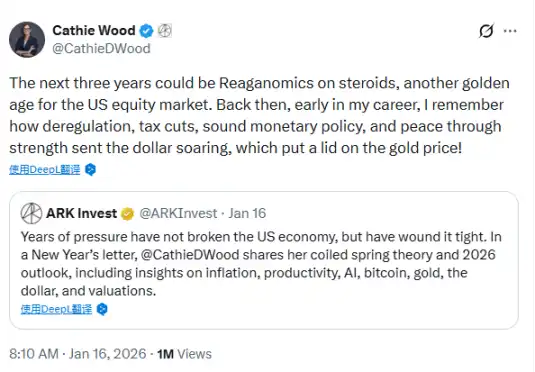
In its latest New Year 2026 letter to investors, ARK Invest's founder, Cathy Wood, published a macro outlook comparing the next three years to "Reaganomics on steroids". She noted that, with deregulation, tax cuts, sound monetary policy and the convergence of innovative technologies, the United States stock market would usher in another “golden age”, and that the upcoming surge in the United States dollar might put an end to the rise in gold prices。
In particular, Cathy Wood argues that, despite the sustained growth of real GDP over the past three years, the bottom economy in the United States has experienced a rolling recession and is now in a state of “coiled swing” and is expected to rebound strongly in the coming years. In particular, she stressed that with David Sachs taking over as the first AI and encrypted currency tsar deregulated, and business effective tax rates moving to 10 per cent, economic growth in the United States would yield significant policy dividends。
At the macro level, Wood predicts that, driven by productivity booms, inflation will be further controlled and may even reverse. She predicts that the nominal GDP growth rate in the United States will remain at 6 to 8 per cent over the next few years, driven largely by productivity growth rather than inflation。
In terms of market impact, Wood predicts that the comparative advantage of the return on investment in the United States will drive the dollar to rise sharply, reproducing the almost doubling of the dollar in the 1980s. She warned that, despite the significant increase in gold prices over the past few years, the strengthening of the United States dollar would suppress the price of gold and that bitcoin would show a different dynamic than gold because of its supply mechanisms and low asset relevance。
Wood does not believe that the AI foam has been formed in response to investor concerns about market valuation. She noted that, although the current rate of market gain was historically high, as technologies such as AI, robots and others drove productivity booms, business profitability would be digested with high valuations, and markets might be able to achieve positive returns at the same time as the rate of market gain was compressed, similar to the cattle market path of the late 1990s。
Here are the original letters to investors:
HAPPY NEW YEAR TO ARK INVESTORS AND OTHER SUPPORTERS! WE ARE VERY GRATEFUL FOR YOUR SUPPORT。
As I have stated in this letter, we do believe that there are many reasons for investors to remain optimistic! I hope you enjoy our discussion. From the perspective of economic history, we are at an important moment。
It's a hot spring
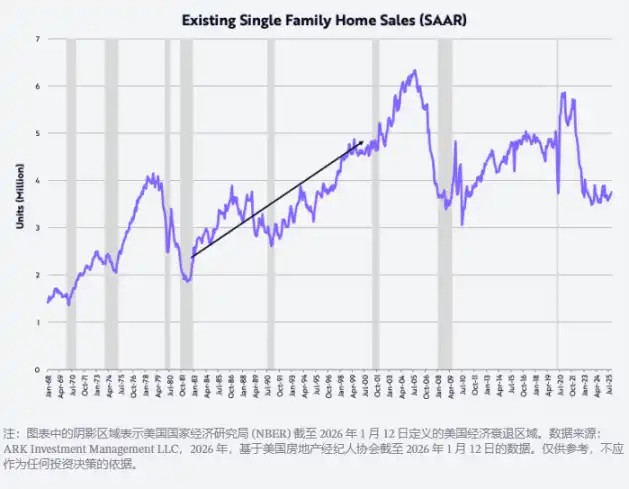
WHILE THE REAL GROSS DOMESTIC PRODUCT (GDP) OF THE UNITED STATES HAS CONTINUED TO GROW OVER THE PAST THREE YEARS, THE BOTTOM STRUCTURE OF THE UNITED STATES ECONOMY HAS EXPERIENCED A ROLLING RECESSION, WHICH HAS EVOLVED INTO A PENETRATING SPRING THAT IS LIKELY TO REBOUND STRONGLY IN THE COMING YEARS. IN RESPONSE TO THE SUPPLY SHOCKS ASSOCIATED WITH THE NEW CORONARY EPIDEMIC, THE FEDERAL RESERVE INCREASED FEDERAL FUND INTEREST RATES FROM 0.25 PER CENT IN MARCH 2022 TO A RECORD 22 TIMES HIGHER IN THE 16 MONTHS TO JULY 2023. THIS INTEREST-RATE INITIATIVE PUSHED INTO RECESSION CAPITAL EXPENDITURES RELATED TO HOUSING, MANUFACTURING, NON-ARTIFICIAL INTELLIGENCE, AND LOW- AND MIDDLE-INCOME GROUPS IN THE UNITED STATES, AS SHOWN IN THE FIGURE BELOW。
In terms of second-hand house sales, the housing market fell by 40 per cent from the annualized 5.9 million in January 2021 to 3.5 million in October 2023. This level last appeared in November 2010, and second-hand house sales have fluctuated around this level over the past two years. This shows how compact the springs are: the current level of second-hand house sales is already the same as in the early 1980s, when the United States had a population of about 35 per cent less。
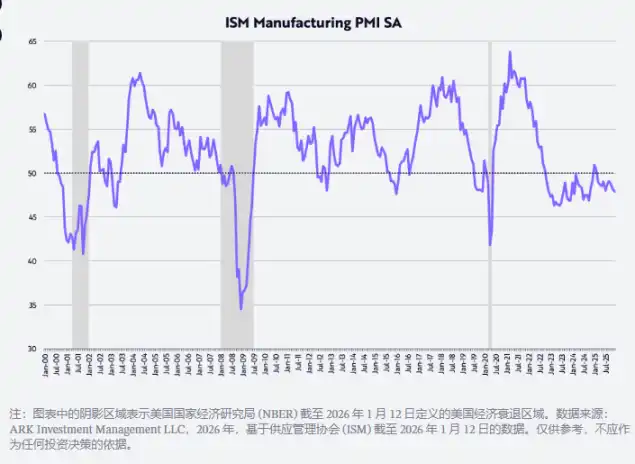
AS MEASURED BY THE UNITED STATES PROCUREMENT MANAGER INDEX (PMI), MANUFACTURING HAS BEEN CONTRACTING FOR ABOUT THREE CONSECUTIVE YEARS. ACCORDING TO THIS PROLIFERATION INDEX, 50 IS THE DIVIDING POINT BETWEEN EXPANSION AND CONTRACTION, AS SHOWN IN THE FIGURE BELOW。
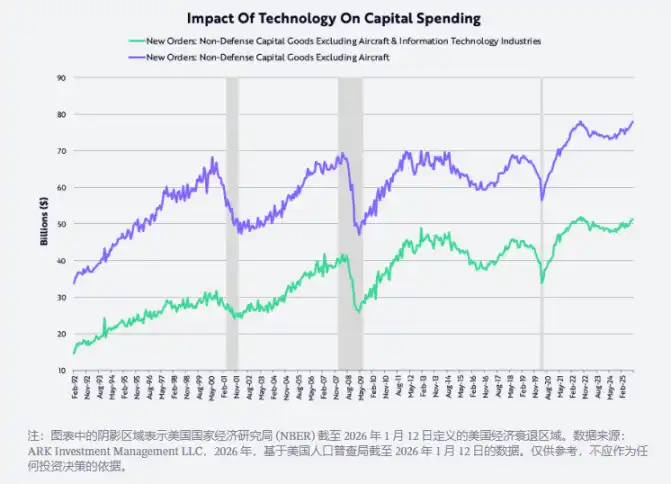
At the same time, capital expenditure, measured as non-defence capital (excluding aircraft), peaked in mid-2022 and has since recovered to that level, regardless of whether it was technically affected or not. Indeed, since the collapse of the technological and telecommunications bubble, this capital expenditure indicator has struggled for more than 20 years to break, until 2021, when the supply shock associated with the new crown disease forced both numbers and real investment to accelerate growth. The previous spending cap seems to have been converted into a spending floor, as artificial intelligence, robotics, energy, block chain technology and multi-group sequencing platforms are ready for the golden age. Following the technological and telecommunications bubble of the 1990s, spending peaks of about $70 billion have continued for 20 years, and this is probably the strongest capital spending cycle in history, as illustrated by the following graph. We believe the emergence of artificial intelligence bubbles is far from imminent
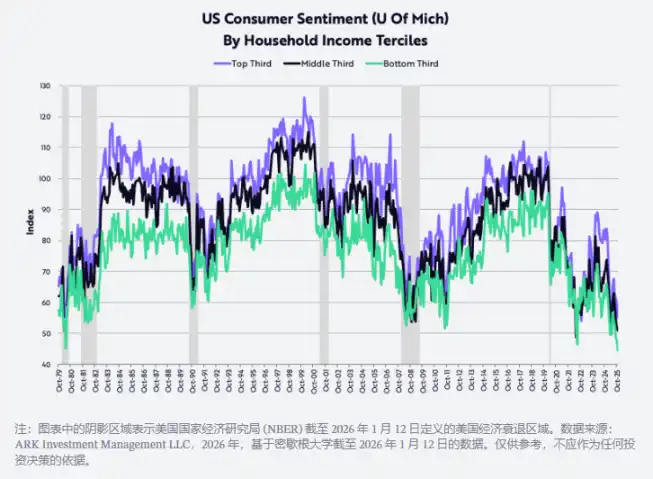
At the same time, data from the University of Michigan show that confidence among low- and middle-income groups has fallen to its lowest level since the early 1980s. At that time, double-digit inflation and high interest rates severely weakened purchasing power and pushed the United States economy into a continuous recession. In addition, confidence among high-income groups has declined in recent months, as shown in the figure below. Consumer confidence, in our view, is one of the “springs” that are currently being squeezed most and have the most rebound potential。
Deregulation while lowering taxes, inflation and interest rates
The rolling recession that the United States has experienced over the past few years, thanks to the combination of deregulation, lower taxes (including tariffs), inflation and interest rates, is likely to reverse rapidly and sharply in the coming year and beyond。
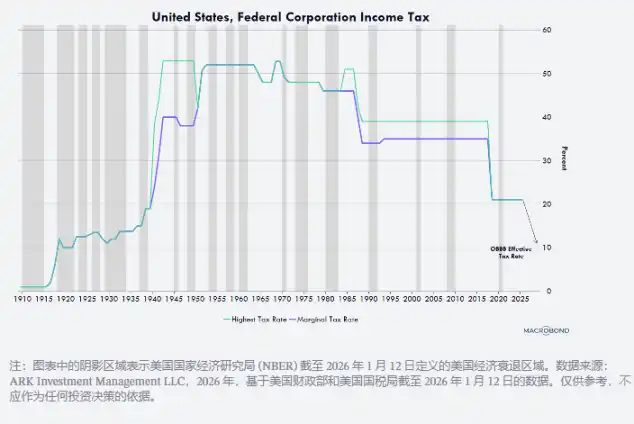
Deregulation is unleashing innovation in various areas, including artificial intelligence and digital assets, led by the first "artificial intelligence and encrypted currency tsar David Sachs." At the same time, the reduction in tips, overtime and social security taxes will result in significant tax rebates for United States consumers in the current quarter, which could boost the annual rate of real disposable income growth from about 2 per cent in the second half of 2025 to about 8.3 per cent in the current quarter. In addition, as manufacturing facilities, equipment, software and domestic R & D expenditures are depreciated at an accelerated rate, firms ' effective tax rates will be reduced to close to 10 per cent (as shown in the figure below), and the scale of corporate tax rebates is expected to increase significantly, with 10 per cent being one of the lowest rates globally。
For example, any enterprise that built a manufacturing plant in the United States by the end of 2028 could achieve full depreciation in the first year of construction, rather than 30 to 40 years as in the past. Equipment, software and domestic R & D expenditure can also achieve 100% depreciation in the first year. This preferential cash flow policy was permanently established in last year ' s budget case and applied retroactively on 1 January 2025。
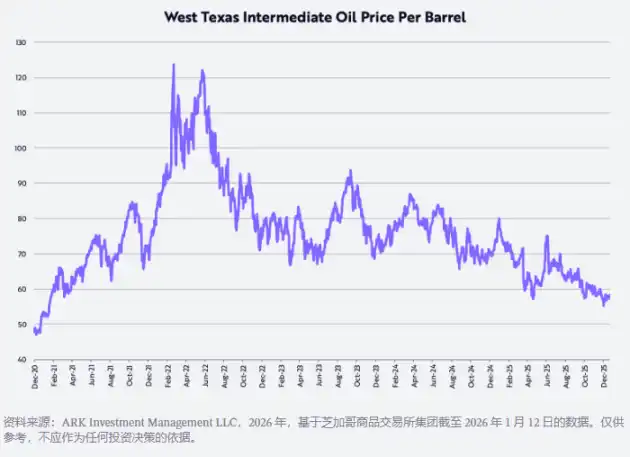
OVER THE PAST FEW YEARS, INFLATION AS MEASURED BY THE CONSUMER PRICE INDEX (CPI) HAS PERSISTED IN THE RANGE OF 2 TO 3 PER CENT, BUT IN THE COMING YEARS, FOR A NUMBER OF REASONS, AS SHOWN IN THE FIGURE BELOW, IT IS LIKELY TO FALL TO AN UNEXPECTEDLY LOW LEVEL – OR EVEN NEGATIVE. FIRST, THE PRICE OF WESTERN TEXAS ' S MEDIUM CRUDE OIL (WTI) HAS FALLEN BY ABOUT 53 PER CENT SINCE THE HEIGHT OF THE NEW CORONARY OUTBREAK OF 8 MARCH 2022, OR ABOUT 22 PER CENT IN THE SAME YEAR。
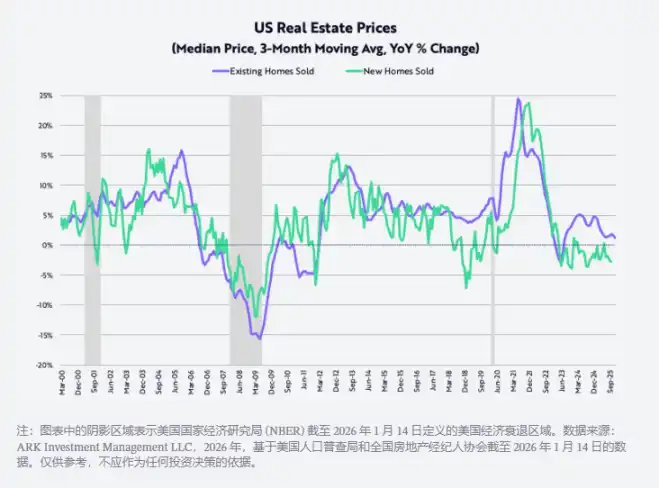
Since it peaked in October 2022, the price of the new single house has declined by about 15 per cent; at the same time, the price inflation rate of the existing single house, based on a three-month moving average, has dropped from about 24 per cent in the same year, to about 1.3 per cent, as shown in the figure below, since the peak of the new coronary outbreak in June 2021。
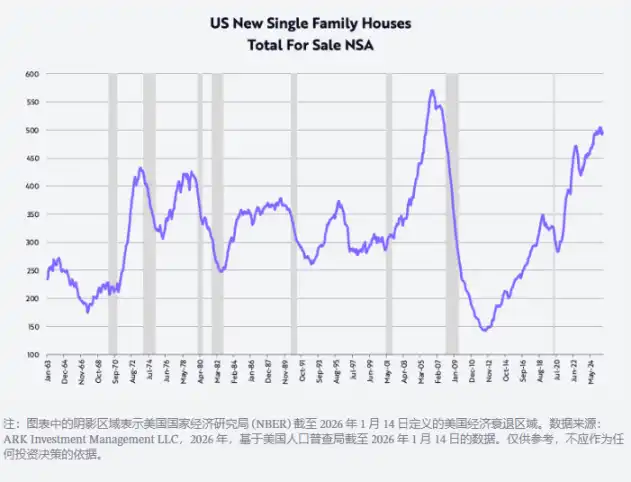
In the fourth quarter, in order to absorb the stock of nearly half a million new single homes (the highest level since the eve of the global financial crisis in October 2007, as shown in the figure below), the three home builders significantly reduced their house prices by 10 per cent in Lennar, 7 per cent in KBHomes and 3 per cent in DRHorton. The effects of these price declines will lag behind in the coming years in the Consumer Price Index (CPI)。
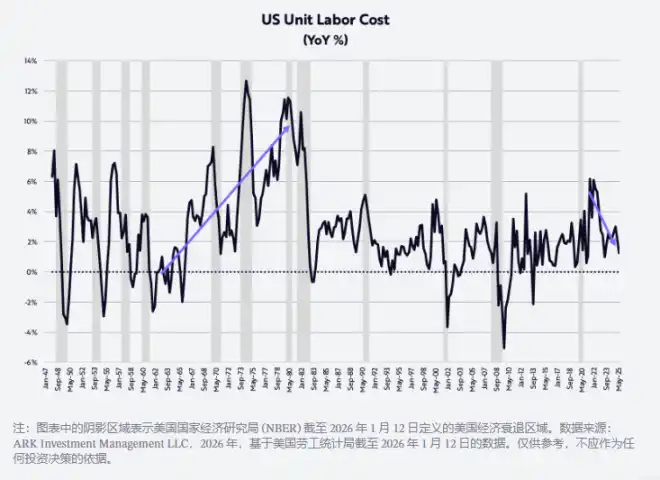
Finally, non-farm productivity, one of the most powerful forces in containing inflation, grew in reverse against the backdrop of a continuing recession, with an increase of 1.9 per cent in the third quarter. In contrast to the 3.2 per cent increase in remuneration per working hour, productivity gains have reduced unit labour cost inflation to 1.2 per cent, as shown below. This figure does not show the kind of cost-driven inflation in the 1970s
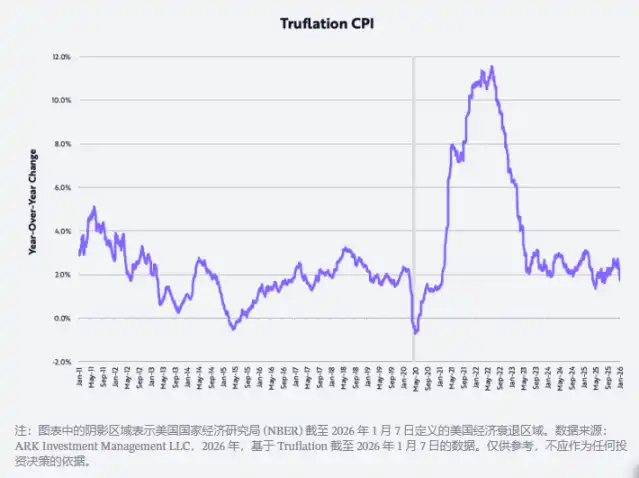
This improvement has also been validated: inflation, as measured by the Transition, has recently declined to 1.7 per cent in comparison with the United States Bureau of Labor Statistics (BLS), which is nearly 100 basis points (bps) below the CPI-based inflation rate, as shown in the figure below。
Productivity boom
Indeed, if we are right to look at technology-driven and subversive innovation, the rate of non-farm productivity growth, influenced by cyclical and long-term factors, should accelerate to 4-6 per cent per year in the coming years, thus further reducing inflation in unit labour costs. The integration of the main innovative platforms currently being developed — artificial intelligence, robotics, energy reserves, public block chain technologies and multi-group technologies — is expected not only to drive productivity growth to sustainable new heights, but also to generate enormous wealth。
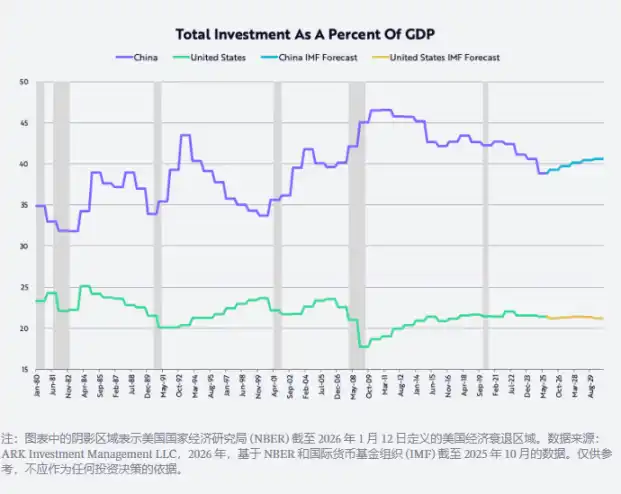
INCREASES IN PRODUCTIVITY COULD ALSO CORRECT SIGNIFICANT GEO-ECONOMIC IMBALANCES IN THE GLOBAL ECONOMY. ENTERPRISES CAN DIRECT THE GAINS FROM PRODUCTIVITY GAINS TO ONE OR MORE OF THE FOLLOWING FOUR STRATEGIC DIRECTIONS: INCREASING PROFITABILITY, INCREASING R & D AND OTHER INVESTMENTS, INCREASING PAY AND/OR REDUCING PRICES. IN CHINA, INCREASING THE REMUNERATION AND/OR PROFITABILITY OF HIGHER-PRODUCTIVITY WORKERS HELPED THE ECONOMY TO EMERGE FROM THE STRUCTURAL PROBLEMS OF OVERINVESTMENT. SINCE JOINING THE WORLD TRADE ORGANIZATION (WTO) IN 2001, CHINA ' S INVESTMENT SHARE OF GDP HAS AVERAGED ABOUT 40 PER CENT, ALMOST DOUBLE THAT OF THE UNITED STATES, AS SHOWN IN THE FIGURE BELOW. INCREASED PAY WOULD DRIVE CHINA ' S ECONOMY TOWARDS A CONSUMPTION-ORIENTED TRANSITION AWAY FROM A COMMERCIALIZED PATH。
HOWEVER, IN THE SHORT TERM, TECHNOLOGY-DRIVEN PRODUCTIVITY INCREASES ARE LIKELY TO CONTINUE SLOWING EMPLOYMENT GROWTH IN THE UNITED STATES, LEADING TO UNEMPLOYMENT RISING FROM 4.4 PER CENT TO MORE THAN 5.0 PER CENT AND PROMPTING THE FEDERAL RESERVE TO CONTINUE TO REDUCE INTEREST RATES. SUBSEQUENTLY, DEREGULATION AND OTHER FISCAL INCENTIVES SHOULD MAGNIFY THE EFFECTS OF LOW INTEREST RATES AND ACCELERATE GDP GROWTH IN THE SECOND HALF OF 2026. AT THE SAME TIME, INFLATION IS LIKELY TO CONTINUE TO SLOW DOWN, NOT ONLY AS A RESULT OF DECLINING OIL PRICES, HOUSE PRICES AND TARIFFS, BUT ALSO AS A RESULT OF TECHNOLOGICAL ADVANCES THAT DRIVE UP PRODUCTIVITY AND LOWER UNIT LABOUR COSTS。
SURPRISINGLY, THE COST OF ARTIFICIAL INTELLIGENCE TRAINING FALLS BY 75 PER CENT PER YEAR, WHILE THE COST OF ARTIFICIAL INTELLIGENCE REASONING (I.E., THE COST OF RUNNING ARTIFICIAL INTELLIGENCE APPLICATION MODELS) FALLS BY 99 PER CENT PER YEAR (BASED ON SOME BASELINE DATA). UNPRECEDENTED REDUCTIONS IN THE COST OF TECHNOLOGIES SHOULD DRIVE A SURGE IN THEIR UNIT GROWTH. SO WE EXPECT THAT THE NOMINAL GDP GROWTH RATE IN THE UNITED STATES WILL REMAIN AT 6 TO 8 PER CENT OVER THE NEXT FEW YEARS, LARGELY AS A RESULT OF PRODUCTIVITY GROWTH OF 5 TO 7 PER CENT, LABOUR FORCE GROWTH OF 1 PER CENT AND INFLATION RATES OF -2 TO + 1 PER CENT。
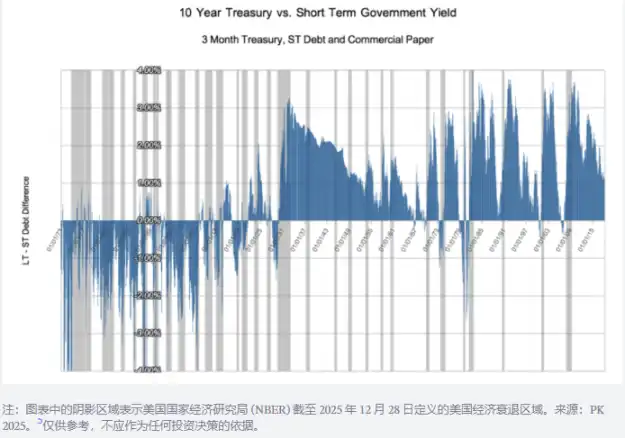
THE DEFLATIONARY EFFECTS OF ARTIFICIAL INTELLIGENCE AND FOUR OTHER INNOVATIVE PLATFORMS WILL ACCUMULATE AND SHAPE AN ECONOMIC ENVIRONMENT SIMILAR TO THE LAST MAJOR TECHNOLOGICAL REVOLUTION TRIGGERED BY INTERNAL COMBUSTION ENGINES, ELECTRICITY AND TELEPHONES IN THE 50-YEAR PERIOD ENDING IN 1929. DURING THAT PERIOD, SHORT-TERM INTEREST RATES WERE SYNCHRONIZED WITH NOMINAL GDP GROWTH, WHILE LONG-TERM INTEREST RATES RESPONDED TO THE DEFLATIONARY DARK CURRENTS ASSOCIATED WITH THE TECHNOLOGICAL BOOM, PUTTING ON AVERAGE THE YIELD CURVE AROUND 100 BASIS POINTS, AS SHOWN IN THE FIGURE BELOW。
Other New Year thinking
Rising gold prices and falling bitcoin prices
DURING 2025, THE PRICE OF GOLD ROSE BY 65 PER CENT, WHILE THE PRICE OF BITCOIN FELL BY 6 PER CENT. MANY OBSERVERS HAVE ATTRIBUTED THE PRICE OF GOLD TO INFLATION RISK, RISING SHARPLY FROM $1,600 PER OUNCE TO $4300 PER OUNCE SINCE OCTOBER 2022, WHEN THE UNITED STATES STOCK MARKET ENDED. ANOTHER EXPLANATION, HOWEVER, IS THAT GLOBAL WEALTH GROWTH (AS EXEMPLIFIED BY THE 93 PER CENT INCREASE IN THE MSCI GLOBAL STOCK INDEX) EXCEEDS THE GLOBAL ANNUALIZED GROWTH RATE OF ABOUT 1.8 PER CENT OF GOLD SUPPLY. IN OTHER WORDS, THE INCREASE IN DEMAND FOR GOLD MAY EXCEED ITS SUPPLY GROWTH. INTERESTINGLY, THE PRICE OF BITCOIN ROSE BY 360 PER CENT DURING THE SAME PERIOD, WHILE ITS SUPPLY GREW BY ONLY ABOUT 1.3 PER CENT ANNUALLY. IT IS WORTH NOTING THAT THE RESPONSE OF GOLD AND BITCOIN MINERS TO THESE PRICE SIGNALS MAY BE QUITE DIFFERENT: GOLD MINING UNIONS RESPOND BY INCREASING GOLD PRODUCTION, WHICH BITCOIN CANNOT DO. ACCORDING TO MATHEMATICAL CALCULATIONS, BITCOIN WILL GROW BY ABOUT 0.82 PER CENT PER YEAR OVER THE NEXT TWO YEARS, AND ITS GROWTH WILL THEN SLOW TO ABOUT 0.41 PER CENT PER YEAR。
Gold prices in the long term
IN TERMS OF MARKET VALUE VERSUS SUPPLY OF M2 CURRENCY, GOLD PRICES WERE ONLY ABOVE THAT LEVEL IN THE PAST 125 YEARS, THE GREAT DEPRESSION OF THE EARLY 1930S. THE PRICE OF GOLD WAS FIXED AT $20.67 PER OUNCE, WHILE THE SUPPLY OF M2 CURRENCY FELL BY ABOUT 30 PER CENT (SEE FIGURE BELOW). RECENTLY, THE RATIO OF GOLD TO M2 HAS SURPASSED ITS PREVIOUS PEAK, WHICH APPEARED IN 1980, WHEN INFLATION AND INTEREST RATES SOARED TO DOUBLE DIGITS. IN OTHER WORDS, FROM A HISTORICAL POINT OF VIEW, GOLD PRICES HAVE REACHED EXTREMELY HIGH LEVELS。
As can be seen from the figure below, the long-term decline in this ratio is closely linked to a robust return on the stock market. According to studies by Ibbotson and Sinquefield, the compound annual rate of return on equities has been about 10 per cent since 1926. After reaching two major long-term peaks in 1934 and 1980 respectively, equity prices as measured by the Dow Jones Industry Average Index (DJIA) achieved a return of 670 per cent and 1015 per cent, or 6 per cent and 12 per cent, respectively, over the 35 years to 1969 and 2001. It is noteworthy that the annualized rates of return on small capitalization were 12 per cent and 13 per cent, respectively。
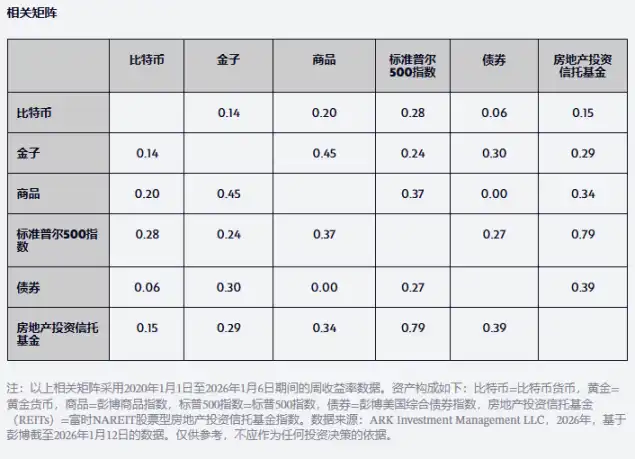
Another important consideration for asset configurors is the low relevance of bitcoin proceeds in relation to gold and, since 2020, to other major asset classes, as shown in the table below. It is noteworthy that Bitcoin is even less relevant to gold than the General 500 index to bonds. In other words, bitcoin should be a good diversified investment option for asset managers seeking higher-risk returns in the coming years。
United States dollar outlook
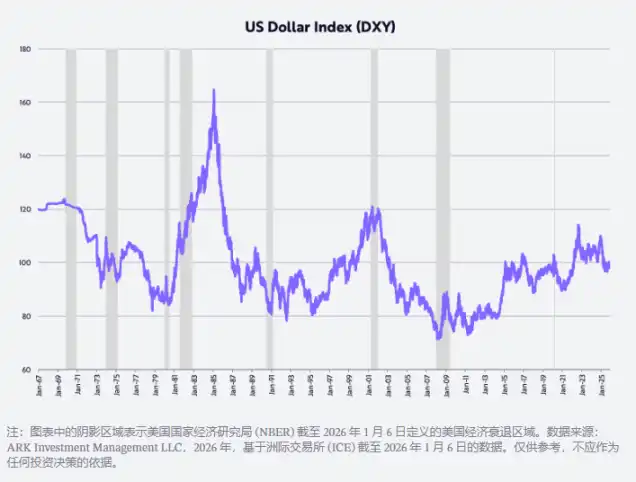
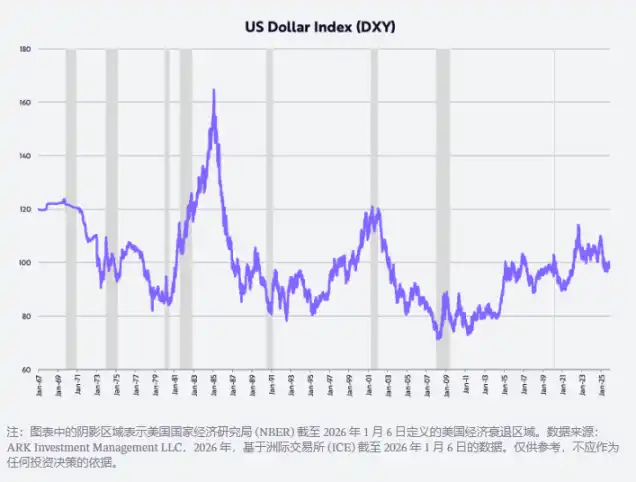
OVER THE PAST FEW YEARS, A POPULAR NARRATIVE HAS BEEN THE END OF THE AMERICAN EXCEPTION, WITH THE DOLLAR FALLING IN THE FIRST HALF OF THE YEAR, THE LARGEST SINCE 1973, AND THE LARGEST DECLINE IN THE YEAR SINCE 2017. LAST YEAR, AS MEASURED BY THE TRADE-WEIGHTED DOLLAR INDEX (DXY), THE DOLLAR FELL BY 11 PER CENT IN THE FIRST HALF OF THE YEAR AND BY 9 PER CENT THROUGHOUT THE YEAR. IF WE ARE RIGHT ABOUT FISCAL POLICY, MONETARY POLICY, DEREGULATION AND UNITED STATES-LED TECHNOLOGICAL BREAKTHROUGHS, THE RETURN ON INVESTMENT IN THE UNITED STATES WILL INCREASE RELATIVE TO THE REST OF THE WORLD, PUSHING THE DOLLAR UP. THE POLICY OF THE TRUMP GOVERNMENT WAS THE SAME AS THAT OF THE ECONOMICS OF THE REAGANS IN THE EARLY 1980S, WHEN THE EXCHANGE RATE OF THE UNITED STATES DOLLAR ALMOST DOUBLED, AS SHOWN IN THE FIGURE BELOW。
Artificial intelligence
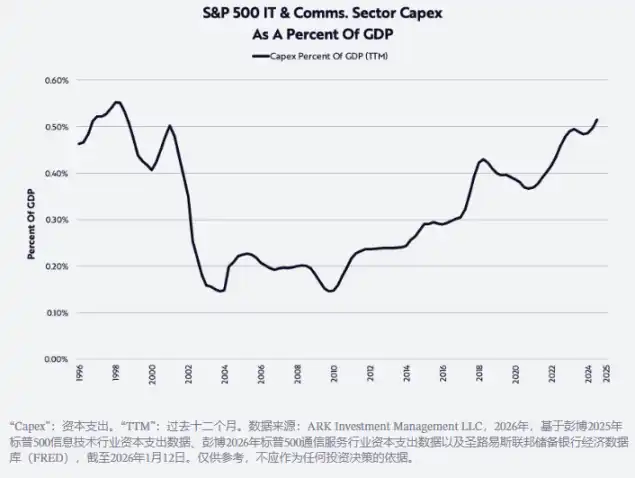
As shown below, the dynamic growth of artificial intelligence is driving capital spending to its highest level since the late 1990s. In 2025, investment in data centre systems (including computing, network and storage equipment) grew by 47 per cent, to nearly $500 billion, and is expected to grow by 20 per cent in 2026, to about $60 billion, much higher than the long-term trend of $150 billion to $200 billion a year of ChatGPT ' s 10 years before its launch. “What is the return on this investment?” Where will it be?"
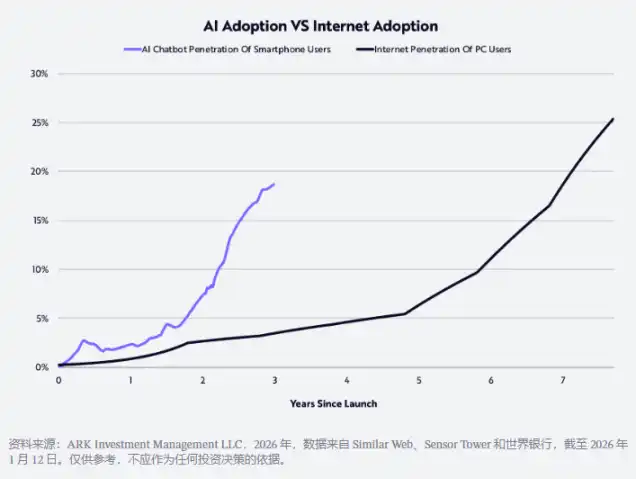
IN ADDITION TO SEMICONDUCTOR AND LISTED LARGE CLOUD COMPANIES, NON-LISTED AI START-UPS ALSO BENEFIT FROM GROWTH AND INVESTMENT RETURNS. AI IS ONE OF THE FASTEST GROWING BUSINESSES IN HISTORY. OUR RESEARCH SHOWS THAT CONSUMERS ACCEPTED AI TWICE AS FAST AS THEY DID IN THE 1990S, AS SHOWN BELOW。
By the end of 2025, it was reported that the annualized revenues of OpenAI and Anthropic would reach $20 billion and $9 billion, respectively, an increase of 12.5 and 90 times, respectively, from $1.6 billion and $100 million over the same period of the previous year! There are rumours that both companies are considering a first public equity (IPO) in the coming year or two to raise funds to support the large-scale investment needed for their product models。
As FidjiSimo, Chief Executive Officer of OpenAI Applications, said, "The capability of artificial intelligence models is far greater than most people experience on a day-to-day basis, and 2026 is just one year of bridging this gap. Leaders in the area of artificial intelligence will be companies that can transform front-line research into products of practical use to individuals, businesses and developers. This year, as users experience more humane, visual and integrated, we are expected to make substantial progress in this area. ChatGPHealth is an early case, an area within the ChatGPT platform dedicated to helping users improve their health based on personal health data。
In enterprises, many artificial intelligence applications are still at an early stage and are subject to preconditions such as bureaucracy, inertia, and/or restructuring and building data infrastructure, resulting in slow progress. By 2026, organizations may realize that they need to use their own data training models and evolve quickly, otherwise they may be left behind by more aggressive competitors. Artificial intelligence-driven applications should be able to provide immediate and excellent customer service, faster product distribution and help start-ups generate more value with fewer resources。
Overvaluation of markets
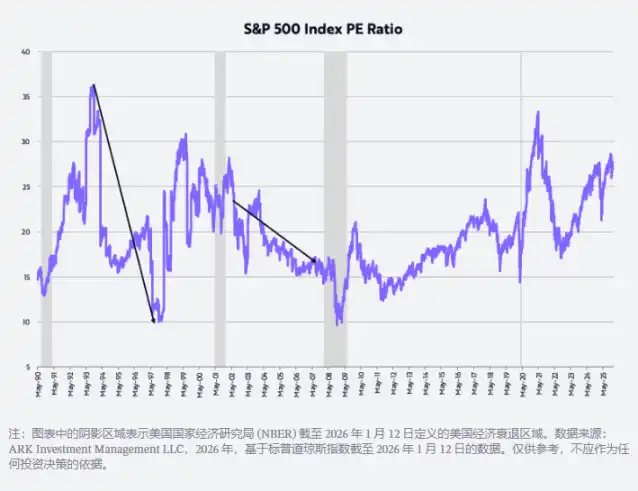
MANY INVESTORS ARE CONCERNED THAT THE STOCK MARKET IS OVERVALUED AND IS NOW AT AN ALL-TIME HIGH, AS SHOWN IN THE FIGURE BELOW. OUR OWN VALUATION ASSUMED THAT THE RATE OF SURPLUS (P/E) WOULD FALL ABOUT 20 TIMES THE AVERAGE OF THE PAST 35 YEARS. SOME OF THE MOST PROMINENT CATTLE MARKETS HAVE BEEN ASSOCIATED WITH THE COMPRESSION OF MARKET EARNINGS. FOR EXAMPLE, BETWEEN MID-OCTOBER 1993 AND MID-NOVEMBER 1997, THE ANNUALIZED RATE OF RETURN ON THE STANDARD 500 INDEX WAS 21 PER CENT, AND ITS MARKET SHARE FELL FROM 36 TO 10 TIMES. SIMILARLY, BETWEEN JULY 2002 AND OCTOBER 2007, THE ANNUALIZED RATE OF RETURN FOR THE STANDARD 500 INDEX WAS 14 PER CENT, AND ITS MARKET SHARE FELL FROM 21 TO 17 TIMES. GIVEN OUR EXPECTATION THAT REAL GDP GROWTH WILL BE DRIVEN BY HIGHER PRODUCTIVITY AND SLOWER INFLATION, THE SAME DYNAMIC SHOULD BE REPEATED, AND POSSIBLY EVEN MORE SIGNIFICANT, IN THE CURRENT MARKET CYCLE。
As always, thanks to ARK investors and other supporters, as well as to Dan, Will, Katie and Keith for helping me write this long New Year message
RECOMMENDED READING:
RootData 2025 Web3 Industry Annual Report
The change of power in the currency: the dilemma of a 300 million-dollar empire
