By Zhixiong Pan
In the second decade of zone chain technology development, the industry is facing a fundamental philosophical and technological paradox: using the Taifung as a world computer. While a value settlement layer without trust has been successfully established, its radical transparency is evolving into a barrier to large-scale adoption. At present, each interaction, asset allocation, pay flow and even social relations of the chain users are exposed in a permanently unmovable public landscape prison. This “glass house”-like state of existence not only violates individual sovereignty, but also excludes the vast majority of institutional capital due to a lack of commercial secrecy。
The year 2025 marked a decisive turn in industry consensus. Vitalik Buterin, a co-founder of the Taifeng complex, has made it clear that "privacy is not a function, but rather a health condition" and defines it as the foundation of freedom and a necessary condition for social order. Just as the development of the Internet from an explicit HTTP to an encrypted HTTPS has led to a boom in e-commerce, Web3 is at a similar threshold. With approximately $119 million in financing, the Aztec Network (Ignition) is promoting the upgrading of infrastructure to programmable privacy through Ignition Chain, Noir Language Ecology, and ecological applications such as zkPassport。
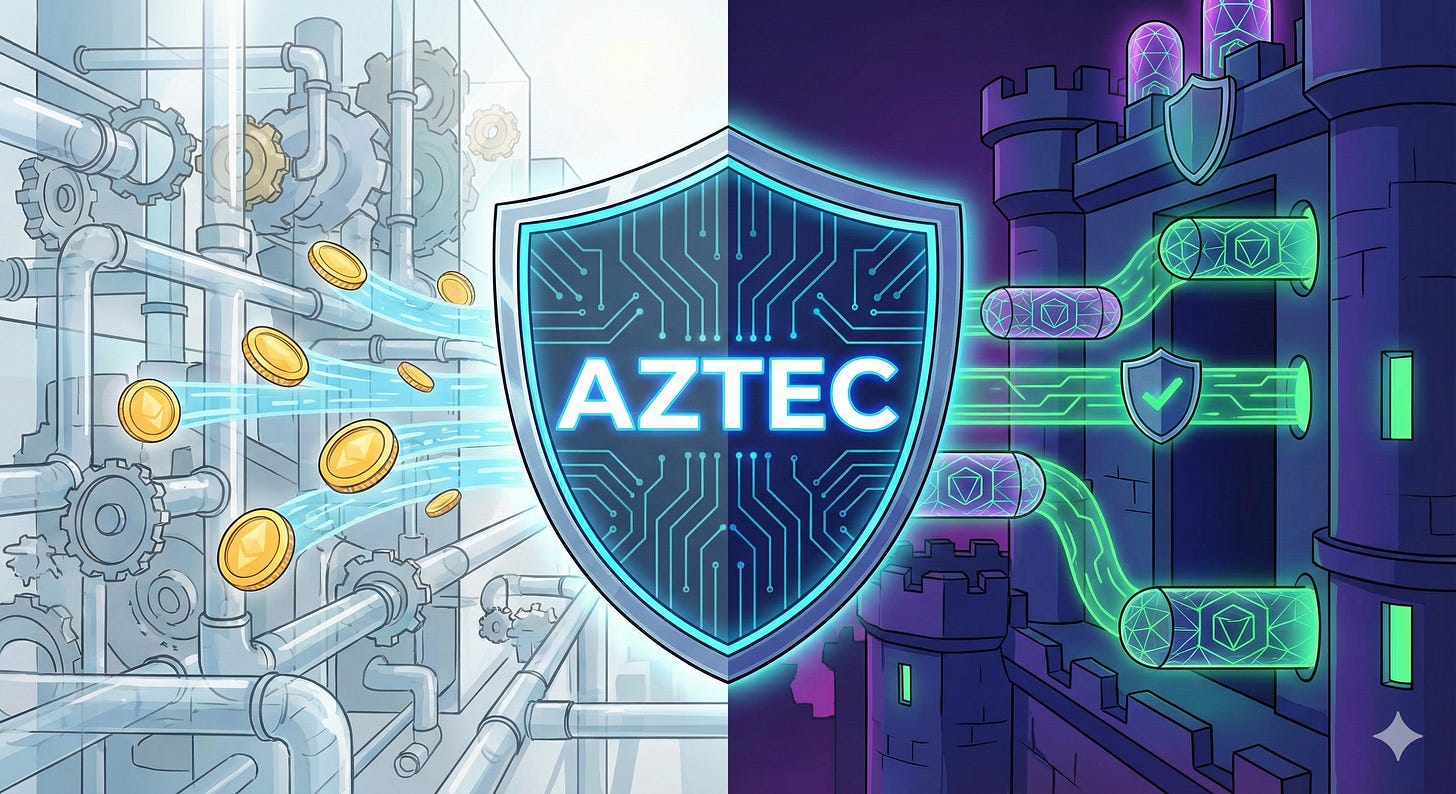
Macro narrative: From a single point to a "overall privacy" defense
The understanding of privacy in Taifung ecology is no longer limited to a single mixed currency agreement, but evolved into a "Holistic Privacy" structure that cuts across the web, hardware and application layers. This paradigm shift became the focus of the industry at the Devconect Congress in 2025, where it was established that privacy protection must be fully defensive。
Reconstruction of software standard: Kohaku and the invisible object address
The Kohaku reference, led by the Privacy Exploration Team (PSE) of the ETA Foundation, marked the move of privacy technology from a "field plug" to a "regular army". Kohaku is not just a wallet SDK, it's trying to fundamentally recreate the account system。
By introducing the "Stealth Meta-Address" mechanism, Kohaku allows the recipient to publish only one static public key, while the sender generates a unique one-time chain address for each transaction based on an elliptical curve code。
For external observers, these transactions, like being sent to random black holes, do not allow for the creation of links with the true identity of the user. In addition, Kohaku provides reusable integrated components around mechanisms such as stealth meta-advices/stealth attachments and attempts to move privacy capabilities from "outside" to a more standardized wallet infrastructure。
Last fort: ZKnox and Quantum Threat
If Kohaku is a software-based logic, then ZKnox, which is funded by the EF and fills the ecological hardware panel, is committed to addressing deeper key security and future threats. With the spread of ZK applications, a growing number of sensitive witness (which may contain key material, identity data or transaction details) requires participation in the certification and signature process on the side of the terminal, thus increasing the risk side of disclosure when the client is invaded. ZKnox focuses more on infrastructure improvements and realization (e.g., promotion of pre-compilation to reduce the cost of coding) that will allow antiquant codes to be "workable and affordable" on the Ether Workshop, paving the way for future migration to PQ signature programs。
More crucially, in the face of the threat that quantum calculations could pose to traditional elliptical curve ciphers in the 1930s, ZKnox focused more on infrastructure work that "makes the antiquator passwords available in the Ether Workshop and affordable enough." EIP-7885, for example, proposes to include NTT pre-compilation in order to reduce the cost of chain validation of grid passwords (including Falcon, etc.) and pave the way for future PQ migration。
Aztec's historical status and technological architecture: defining "private world computers"
In the evolution of the private track, Aztec has a unique ecological position. Unlike the bitcoin-era pseudonym regime, it goes beyond the single "tradable privacy" offered by Zcash or Tornado Cash, and Aztec is committed to the full "programmable privacy" of Turing. Its core team consists of co-inventors of the PLONK Zero Knowledge Certification System, which gives Aztec a deep genetic ability to create a code。
Mixed state model (Hybrid State): Breaking the impossible triangle
The biggest challenge in building a private smart contract platform is how to deal with the state. The traditional block chains are either open (e.g. the Ether) or private (e.g. Zcash). Aztec creatively presented a hybrid state model: at the private level, it uses a bitcoin-like UTXO model to store user assets and data as encrypted "Notes"。
These instruments are expressed as " spent/defunct" by generating corresponding nullifeers, thus preventing double flowers and maintaining privacy in relation to the content and ownership of the instrument. At the public level, Aztec maintains publicly verifiable public conditions, which are updated by a public function in a network-side public execution environment。
This architecture allows developers to combine private and public functions in the same smart contract. For example, a decentrized ballot should be used to make public the general status of "total votes" but to keep the words "who voted" and "what voted" strictly confidential through private status。
DOUBLE EXECUTION MODEL: PXE AND AVM CONCERT
Aztec execution is broken down into two tiers of client and network: private function executes and generates certificates and commitments related to private status in the PXE of the client; public status conversion is performed by sequencer (operating the public execution environment/VM) and generates (or commissioning the production of a prover network) validity certificate that can be validated in the Taipei。
- Client-Side Proving: All private data processing takes place in the private execution environment (PXE) where the user is located. Whether generating transactions or computing logic, the user ' s private key and explicit data have never left his device. PXE is responsible for running circuits locally and generating a zero-knowledge certificate。
- PUBLIC IMPLEMENTATION AND VALIDATION (AVM): THE USER ONLY SUBMITS THE RESULTING CERTIFICATE TO THE NETWORK. THE NETWORK SIDE, BY SORTER/OUT BOARD, VALIDATES THE PRIVATE CERTIFICATE AND RE-EXECUTS THE PUBLIC PART DURING THE PACKING PROCESS, AND THE PUBLIC CONTRACT LOGIC IS IMPLEMENTED IN AVM AND INCORPORATED INTO THE VALIDITY CERTIFICATE THAT CAN EVENTUALLY BE VALIDATED AT THE ETHER. THIS SPLITTING OF "PRIVATE INPUT TO THE CLIENT, PUBLIC STATUS CONVERSION TO BE VALIDATED" COMPRESSES PRIVACY AND PROBABILITY CONFLICTS TO THE BOUNDARIES OF A PROVEN INTERFACE, WITHOUT THE NEED TO MAKE ALL EXPLICIT DATA AVAILABLE ON THE INTERNET。
Interoperability and cross-layer communication: Portals and step-by-step messaging
Under the Ignition structure, Aztec does not represent the operation of the DeFi command by using the Taifeng as a "backstage implementation engine" but creates L1↔ L2 communications abstracted through Portals. Since private execution requires "preparation and proof" in advance of the client, and public state modification must be performed by seguencer at the end of the chain, Aztec 's cross-domain call is designed as a one-way, different-step message transfer model: L2 contracts can initiate a call intention (or reverse) from L1 portal, and messages become consumerized in the subsequent block through the Rollup mechanism, with applications requiring visible treatment of failure and rollback scenarios。
Rollup requires the key functions of maintaining the state roots, certifying the state of transition and handling the message queue, thus allowing for a combination of the ETA while maintaining privacy constraints。
Strategic Engine: Democratization of Noir Language and Zero Knowledge Development
If Ignition Chain is the torso of Aztec, then the Noir language is its soul. For a long time, the development of zero-knowledge proof of application has been limited to "brain problems", with developers having to be both senior cipherists and skilled engineers, and manual translation of business logic into bottom-of-the-ground arithmetical circuits and multiple restraints, which are not only inefficient but also very easy to introduce security loopholes。
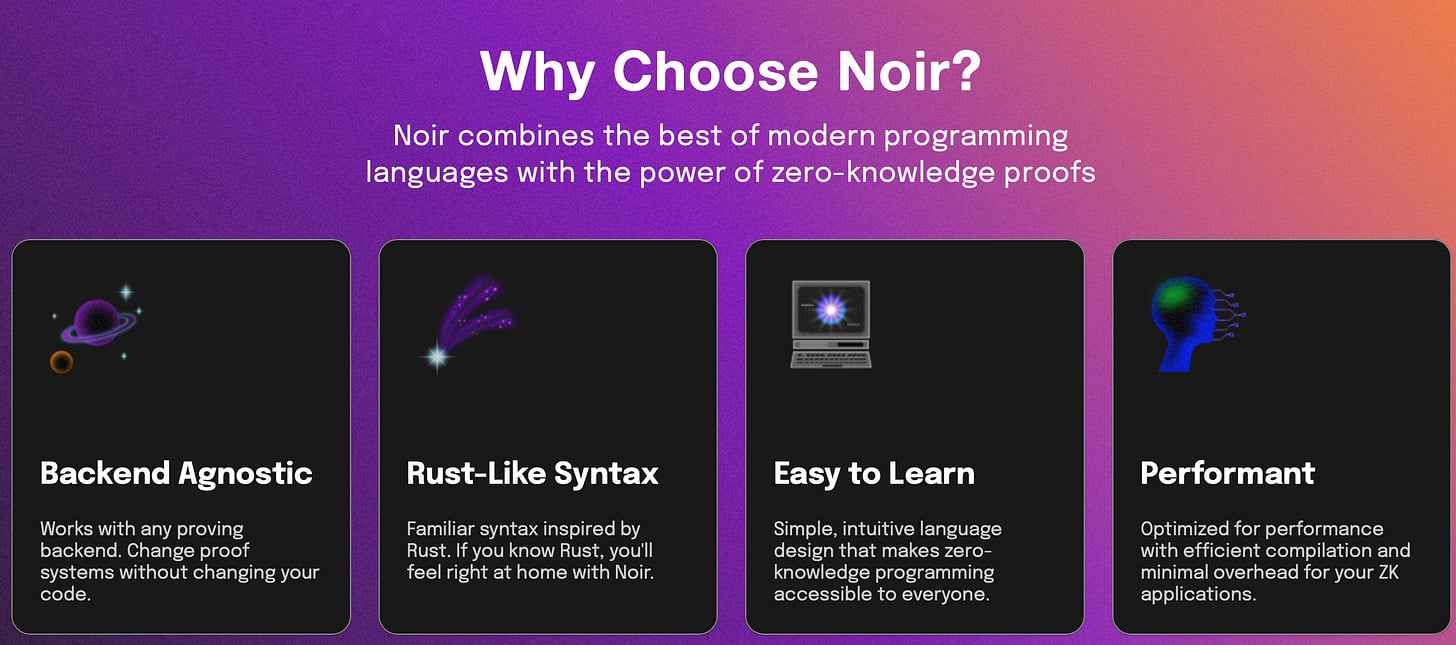
The abstract force has nothing to do with the back end
Noir emerged to put an end to this "Babetta" era. As an open source field-specific language (DSL), Noir uses modern syntax similar to Rust to support advanced features such as circulation, structure, function call. According to the developer of Electrich Capital, the number of code numbers using Noir to produce complex logic is only one tenth of the traditional circuit language (e.g. Halo2 or Circom). For example, the Payy Privacy Payment Network, after migrating to Noir, reduced its core code library from thousands of lines to about 250 lines。
More strategically, Noir's Backend Invisibility. The Noir code is compiled into an intermediate expression layer (ACIR) that allows for the docking of any supporting certification system。
Noir decomposes circuit expression with specific proof systems by ACIR: by default, Barretenberg is attached to the Aztec protocol stack, and ACIR can be converted/adapted to different backends such as Groth16 outside the chain or in other systems. This flexibility makes Noir a common standard across the ZK field, breaking down barriers between ecosystems。
The ecological eruption and the development of the moat
The data attest to the success of the Noir strategy. In the annual report of Electric Capital, Aztec/Noir ecology ranks for two consecutive years among the top five ecosystems with the fastest growth of industry-wide developers. More than 600 projects in GitHub have been built using Noir, covering from zkeEmail to complex DeFi protocols。
By organizing the NoirCon Global Developer's Congress, Aztec not only consolidated its technology moat, but also fostered an active private acoustic application ecology that bodes well for the impending outbreak of a cold war。
Web-based cornerstone: the centralization of Ignition Chain
In November 2025, Aztec was on the Internet of the Taifeng Owners Ignition Chain (the current phase is dominated by decentrization and certification process exercises, with trading and contract execution expected to be gradually opened at the beginning of 2026). This is not just a technological milestone, it's also a radical exercise in Layer 2's commitment to decentrization。
The courage to go to centre stage
In the current Layer 2 expansion competition, the vast majority of networks (e.g. Optimism, Arbitrum) relied on a single centralized sorter (Sequencer) to safeguard their performance at the start of the start-up, decentrizing until the fuzzy future。
Aztec has chosen a very different path: Ignition Chain has been operating from the start on a decentralized certifier/sorting board structure and has tried to pre-position key privileges to open certifiers. The network triggers the creation of a block after the certifier ranks up to a threshold of 500 and attracts 600+ certifiers to participate in the block and endorsement processes at an early stage after they are online。
This design is not exhaustive, it is the bottom line of privacy networks. If the sorter is central, the regulator or a strong authority can easily pressure it to review or reject the address-specific privacy transaction, thus rendering the entire privacy network meaningless. Decentreized sorters/committees remove single single sorter review points and significantly increase the anti-censorship character of the packaged transactions, provided that there are " honest participants and the agreement is established " 。
Performance road map
While decentrization brings security, it also poses a challenge to performance. The current Ignition Chain block generation time is approximately 36-72 seconds. Aztec ' s road map aims to gradually reduce the current longer break between out of blocks to about 3 & ndash through parallel proof of generation and optimization of the network layer; and 4 seconds (target time point is the end of 2026) in order to be close to the interactive experience of the Taipei host network. This marks a move from "available" to "high performance" for privacy networks。
Killer-level application: zkPassport and compliance paradigm shift
The technology itself is cold until it finds an application to address the real pain of humankind. zkPassport, which is more precisely one of the identification/compliance signals tools in the Noir ecology, explores the compromise between privacy and compliance by using its own circuits in its own scene to certify compliance with minimum disclosure, such as sanctions list checks。
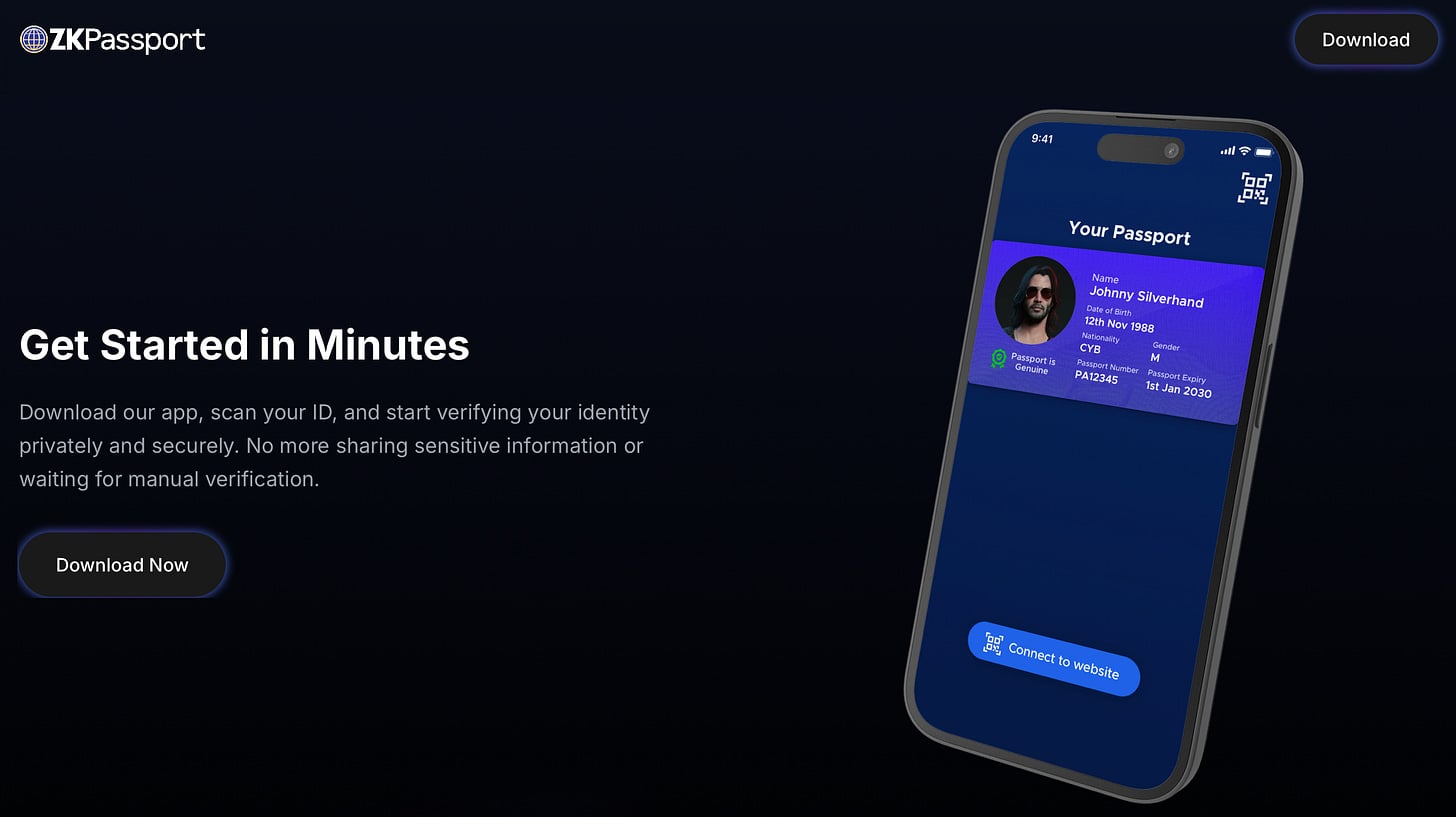
From data collection to factual verification
The traditional KYC (know your customer) process, which requires users to upload passport photographs and identity documents to centralised servers, is not only cumbersome, but also creates numerous more vulnerable data honey cans. zkPassport totally subverts this logic: it uses NFC chips and government digital signatures inserted in modern electronic passports to read and verify identity information locally through physical contact with passports by mobile phones。
Subsequently, the Noir circuit generated zero-knowledge proof in the local environment of the user ' s mobile phone. Users can apply the facts of being "at least 18 years of age " , "nationality is a list of permissible/not a list of prohibited jurisdictions" and "checking the unfailed sanctions list" without disclosing the full date of birth, passport number, etc。
Protection against witch attacks and access to institutions
the meaning of zkPassport is far beyond authentication. By producing anonymous passport-based identifiers, it provides DAO governance and airdrop distribution with a powerful "Sybil Research" tool that ensures fairness in "one person, one vote" while eliminating the possibility of reverse tracking the true identity of users。
At the practical level, such verifiable and minimally disclosed compliance signals are expected to reduce the friction of financial compliance in the chain of institutional participation, but they are not equivalent to a complete KYC/AML process. Institutions can demonstrate their compliance by zkPassport and participate in financial activities along the chain without exposing transaction strategies and the size of the funds. Through this application, Aztec demonstrates that compliance does not necessarily mean the establishment of a panorama prison, and that technology can achieve both regulatory requirements and personal privacy。
ECONOMIC MODEL: CONSECUTIVE LIQUIDATION AUCTIONS (CA) AND FAIR DISTRIBUTION
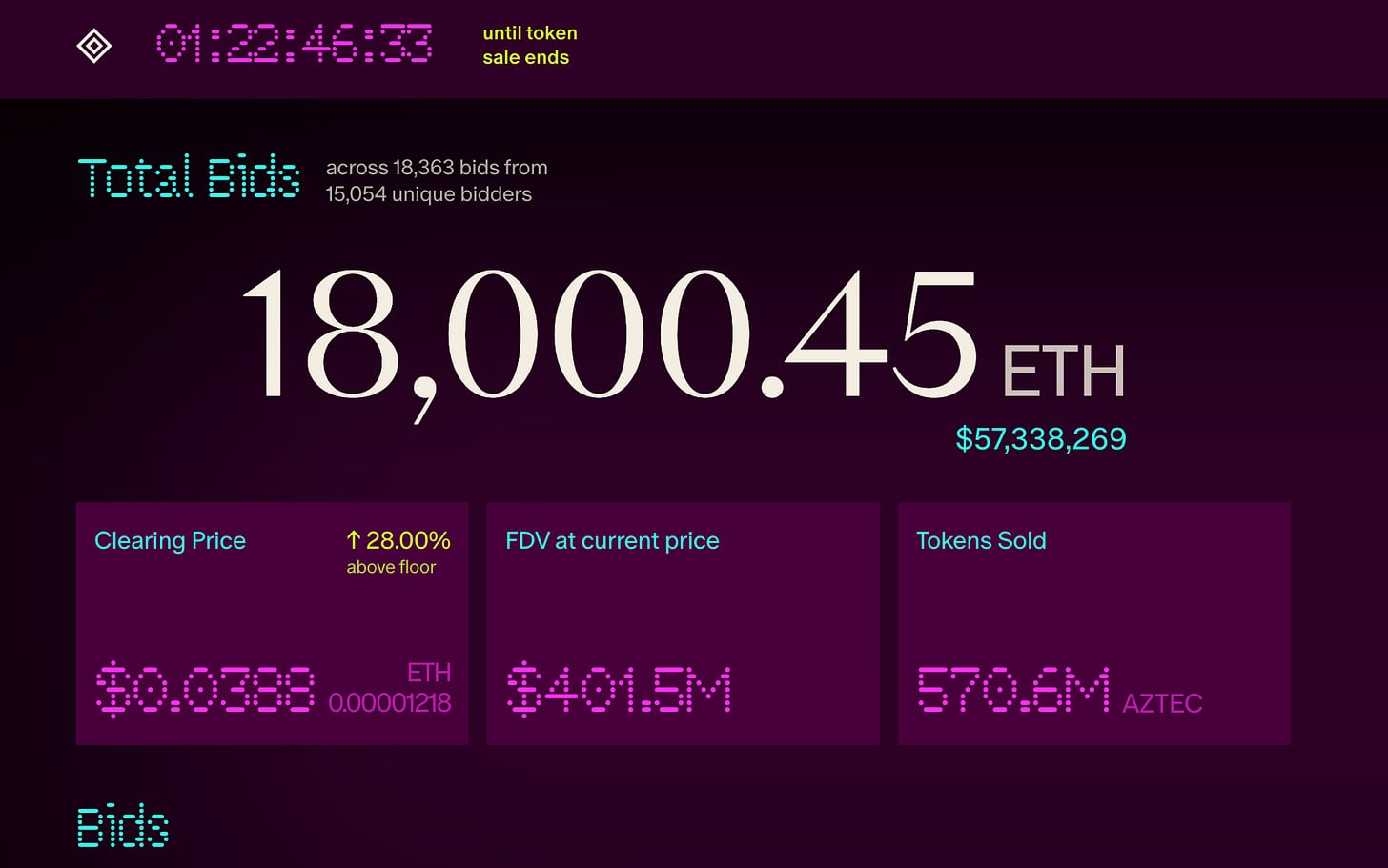
As fuel for the de-centre network, the issuance mechanism of the original currency AZTEC itself reflects the extreme quest for equity on the part of the projecter. Aztec has abandoned the traditional distribution patterns that easily lead to the Sniping and Gas-Fear Wars, and the United Uniswap Labs has introduced the innovative "Casa, Continuous Clearing Action"。
PRICE DISCOVERY AND COUNTER MEV
The CCA mechanism allows the market to engage in sufficient games within the time window set to discover the real price. During each of the CCA liquidation cycles, the transaction is settled at a unified clearing price, thereby reducing the run-off and Gas bid space that arises in order to pre-offer. Such a mechanism effectively eliminates the profit margin of the runners and allows the diaspora investors to stand on the same line as the whale。
Liquidity of agreements
More innovatively, the CCA has achieved an automated closed loop between distribution and mobility. The auction contract can automatically inject (partly) the auction proceeds and tokens into the Uniswap v4 mobility pool by pre-disclosed parameters, creating a chain-verifiable "issue & rarr; liquidity" closed loop。
This means that the AZTEC tokens have had deep chain mobility from the very first days of their existence, avoiding the boom and fall that are common to new currencies on the market and protecting the interests of early community participants. This more deFi distribution and liquidity-led approach is also often used to illustrate how AMM can be achieved by expanding from a “transaction infrastructure” to a “issue infrastructure”。
Conclusion: The "HTTPS Age" of building Web3
The ecological landscape of Aztec Network, from the lower Noir language standard to the upper zkPassport application, to the Internet load of Ignition Chain, is transforming the "HTTPS Upgrading" long-term vision of the Taifeng community into an available engineering reality. This is not an isolated technical experiment, but rather a structured privacy defence system, from hardware to application, in line with the initiative of the Taicong natives of Kohaku and ZKnox。
If the early stages of the development of the block chain establish value settlements without trust, then the central theme that follows will be to establish the autonomy and confidentiality of data. In this process, Aztec plays an essential infrastructure role: It does not attempt to replace the transparency of the Taifeng, but rather completes its missing half by "programmable privacy". As technology matures and compliance frameworks improve, we can expect a privacy that is no longer an "additional function" It's the future of the "default attributes", a "private world computer" that preserves the probabilities of public books while respecting individual digital boundaries。