
The Cosmos Eco Ace Noble ran away, and mobility crushed the once King across the chain
Noble's migration exposed the embarrassment of IBC: it connects the world, but it doesn't keep the project -- everybody connects to the end, and wants to go to EVM。
It's not like it's the same
On January 20, the Cosmos application chain, which focuses on the stabilization currency, Noble announced that it would move from the Cosmos ecology to an independent EVM L1 network. Noble EVM is scheduled to start on March 18, and the team will continue to support the Cosmos-based block chain in the short term. After the move, the Noble ' s own USDN stability currency will become the core function of EVM L1, and the NOBLE token will serve as a governance asset, closely linking agreement decision-making and value to the use of the stable currency throughout the network。
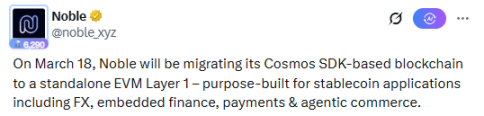
Figure source: Noble tweet
Then, Cosmos FounderCommunicationsThe response stated that the Noble transition was not a departure from the Cosmos vision, but rather a reflection of the core concept of “sovereignty and interoperability”. Noble's migration does not imply disconnection from Cosmos Hub. On the contrary, through the IBC v2 agreement, the relocated Noble EVM will be the key bridge between the EVM ecology and the Cosmos economies. He said, "We are entering an era that is no longer chain-based, but mobile."。
Cosmos' stabilization card. Why run away
Noble is one of the most successful stabilization currency infrastructure projects in the Cosmos ecology. It is the original Circle USDC-Cosmos ecological chain, which distributes USDC safely and without friction to the 50+ chain through IBC, and has cumulatively processed over $22 billion in transactions。
The presence of Noble has given Cosmos ecology the competitiveness of a “natural stable currency” and avoided the risk of trust relying on external bridges。
But why is Noble moving? Noble's official justification is realistic:
EVM ecology is absolutely dominant. 75% more stable currency markets on the EVM chain. The developers, tools, wallets, and dApp are all focused on EVM, and Noble wants to be a "stabilized currency infrastructure L1," and has to follow money and people。
EVM technology warehouse is more friendly to developers. EVM has mature collections of tools such as Solidity, Remix, Hardhat and easier access to agreements such as Uniswap and Aave. Cosmos SDK is strong, but learning curves are steep and ecological tools are relatively backward。
EVM has better performances and real world examples. Noble EVM pursues sub-second delays, targeting payment, embedded finance, events such as economic company, FX. The Tempermint consensus of Cosmos is reliable, but the EVM warehouse can better match the mainstream payment chain。
Noble himself has strategic ambitions. Noble does not want to be an "toolman" in Cosmos, but rather to become an independent, high-performance stability currency, Layer 1, directly competing for other stable currency chains。
So Noble voted with his feet. Cosmos gave it the soil to start, but EVM gave it a big future。
Noble ran away with Cosmos' half-life
Noble is the only "super-maximum" in Cosmos. Noble's 30 days of IBC transactions amounted to $93.84 million, which is 1.8 times the second-ranked Osmosis ($50.06 million). Of the 110 Zones linked to Cosmos IBC, Noble contributes to fault-level mobility。
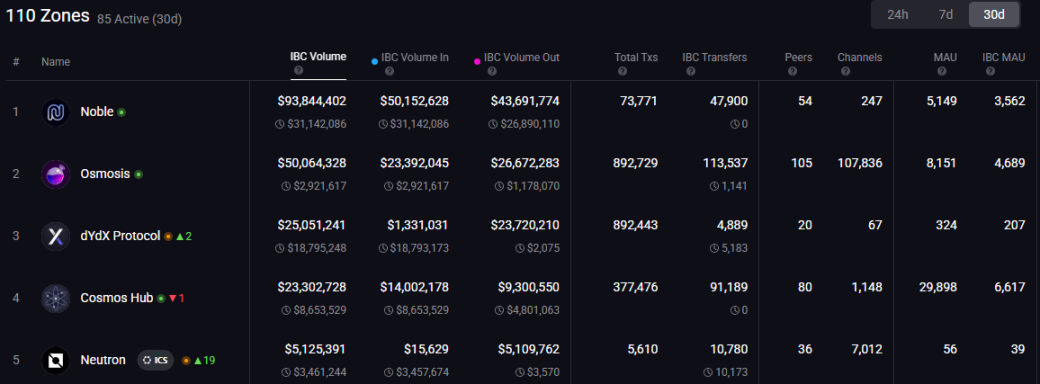
SOURCE: MAP OF ZONES
Noble is the "water tap" for institutional funding. Osmosis' number of transactions is close to 900,000, while Noble has only 73,000. This means that the single transaction value of Noble is much higher than that of other chains, and that it carries not a small exchange of bulk, but a stable settlement and large distribution at the institutional level。
Although IBC links 110 Zones, only 85 remain active. That means 23% of the chain is already dead. Liquidity is highly concentrated in the first four chains, while the number of out-of-the-box projects has shrunk to millions of dollars a month and ecological retail activity has been severely overstretched。
Cosmos Hub has about 30,000 live users, six times more than Noble (about 5,000 people). However, the money went to Noble. Cosmos users are mostly pledged or watched on Hub, while the real exchange of value-exchange stabilization currency is almost the same as Noble。
Cosmos' ecological soul, the IBC, how does it work
The central narrative of Cosmos is "Internet of Blockchains" — the Internet of Block Chains — and it is IBC (Inter-Blockchain Commission Protocol, Inter- Block Interlinking Protocol)。
IBC is the most unique and successful invention of Cosmos. It allows an independent chain of sovereignty to communicate and transfer to one another without trusting third parties, like the Internet TCP/IP. Its core features are:
minimize trust: verify the state of each other ' s chain through a light link without the need for hosting assets or multiple signing bridges。
Unlicensed interconnectivity: Anyone can establish a channel (channel) to support currency transfers, cross-chain accounts, cross-chain queries, etc。
Universality: An open-ended consensus mechanism, which connects 110+s (Map of Zones data) or even extends to non-Cosmos chains such as Etheum, Optimism。
IBC has a high level of security and has never been subject to large-scale expluit, cumulative transfers of tens of billions of dollars. Even if the other parts of Cosmos are controversial, IBC itself is still the industry's top interoperability program。
But the migration of Noble also exposed the embarrassment of the IBC: it connects the world, but it doesn't keep the project -- everybody connects to the end and wants to go to the EVM single-chain dominance。
Escape Hammer: Which Cosmos projects died or moved in 2025-2026
From 2025 to early 2026, the Cosmos ecology experienced a serious "project escape/ closure wave"。
Most of the projects that were completely closed or shut down were dead in 2025, leaving only community regrets and sporadic attempts at maintenance。
The privacy chain, Penumbra, was completely closed, the team withdrew, and the chain, although barely sustained by the community, was largely unattended, and became the most typical case of "death." Pryzm was also completely closed, and Comdex and Kujira fell down, and the latter even took the Fusion and Levana projects, and the entire DeFi ecological chain broke。
Stride official sunset, shut down; Quasar and Tower died after each other, and Picasso/Composable collapsed and trapped the SOL assets that were connected to the bridge, with no user blood. Drop gave up TGE and sunset, Milkyway closed, Demex failed to recover after the hacker incident, and Evmos died。
The projects covered multiple tracks, such as DEX, borrowing, privacy, NFT and others, mostly because of weak growth, insufficient income, team loss and long-term aftershocks following the Terra crash。
At the same time, some projects have opted for relocation to non-Cosmos bars or the maximum back puncture for the Cosmos narrative. Apart from Noble, Sei had previously decided to abandon the double-barrel structure in the SIP-3 upgrade and planned to retain only the EVM chain until mid-2026。
Arkash is moving to Solana, Elys, pStake, Jackal, Omniflix, etc., and moving to Base, Stargaze and planning to move to Cosmos Hub, Shade Protocol (renamed Feather) and possibly to Sei。
The core motivations for these movements are almost identical: EVM eco-developers tools, liquidity, markets that are much larger than Cosmos, where projecters vote with their feet to choose to follow money and opportunities。
A further number of projects, though not dead, have entered maintenance mode or re-directed resources and the project has been slow。
Osmosis enters the maintenance model and, while maintaining token economics and other updates, there is a marked outward movement of team resources and a sharp decline in activity; Astroport is similar and largely stagnant; and the impact of the original project has been drastically reduced by the acquisition of the Axelar team by Circle. These projects, which were the pillars of Cosmos DeFi, are now a microcosm of ecological contraction。
Mantra went through reorganization (retrenchment in January 2026, cost optimization) and OM token crash (down by almost 99 per cent), but the project is still moving forward. The IBC-compatible RWA EVM L1 operation will continue in the development of functions such as RWA vaaults, launchpad and so on。
In addition, a large number of DEXs, such as Wynd, Hopers, Junoswap, Loop, TerraSwap and others, were closed in 2024-2025. Retail DeFi is basically cool, only the agency and RWA are tough。
MAP OF ZONES shows that IBC is connected to 110 chains, but IBC traffic is highly concentrated in the first few (Noble, Osmosis, Cosmos Hub), and once Noble moves away, the whole ecology becomes more active。
Although Cosmos 2026's Road Map seeks to reverse the decline by upgrading EVM compatibility and high performance, Noble's "runaway" undoubtedly reveals a cruel reality: In the face of mobility, technical narratives tend to appear pale。
