
Google, Circe, Stripeza makes AI spend money, 2026Q1 pays the giants' pleasures and worries
The real enemy is no longer each other, but zero costs per se

Man, Kaori
Edit
In the first three months of 2026, the people who paid for the track were very well-off。
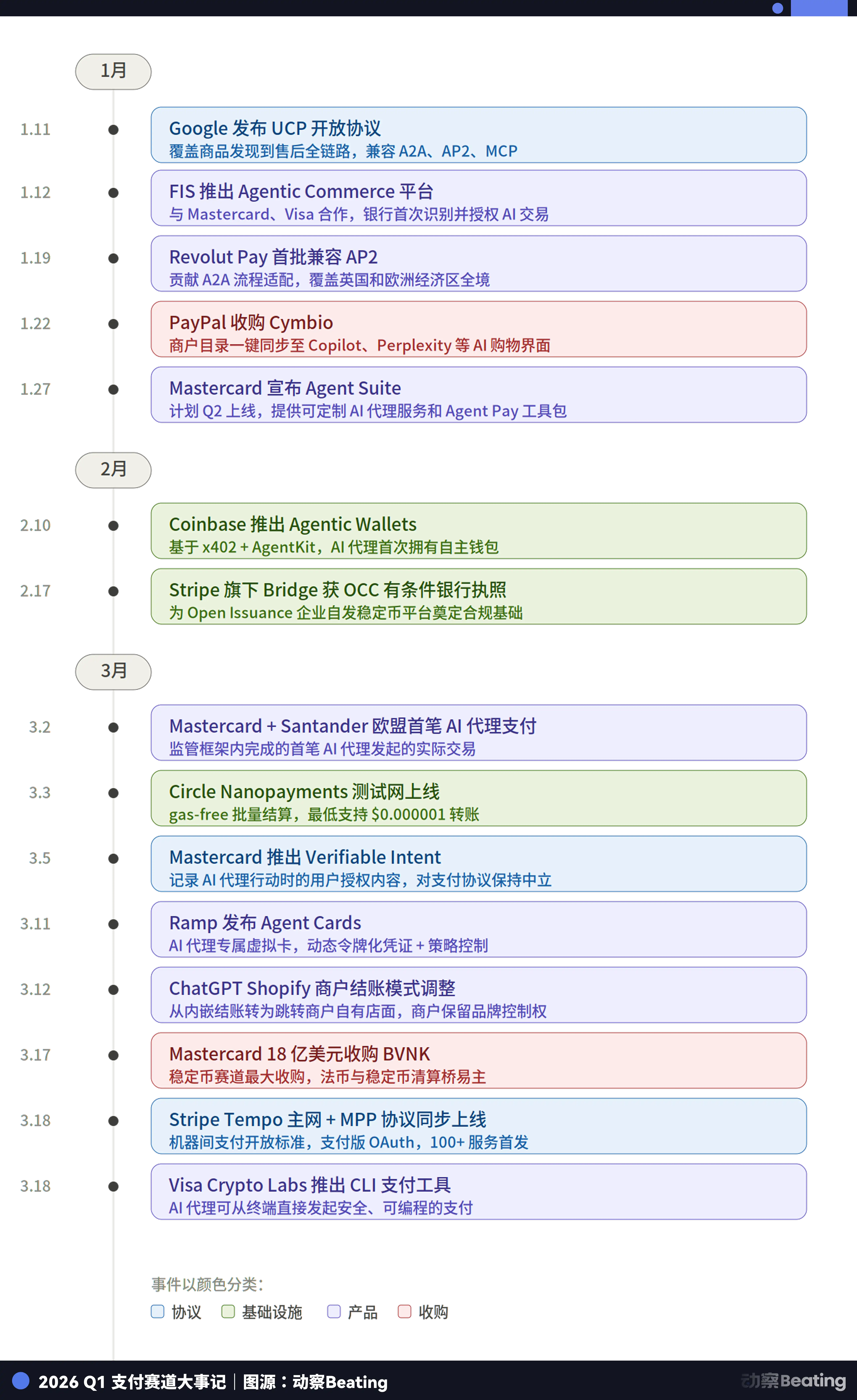
On 11 January, Google launched the United Market Protocol (UCP) at the annual meeting of the United States Federation of Retail Trades, in an attempt to define the common language of AI Business. In the same week, Revolut announced the first EU payment modality compatible with Google AP2, and PayPal announced the acquisition of the Business Directory Synchronization, Cymbio, MasterCard, to launch the Agent Suite package。
In February, Coinbase officially released Agenic Wallets, allowing AI Agent to own his own wallet and to own money, make money and trade encrypted assets. The x402 protocol and the Google system deep integration has processed over 50 million transactions。
March was more intense. Circle released Nanopayments, Ramp launched Agent Cards, MasterCard announced the purchase of BVNK, Stripe and Paradigm hatching Tempo main line and the simultaneous release of the Machine Payments Protocol (MPP) agreement with up to $1.8 billion。
In three months, more than a dozen pounds of action, with mixed feelings. These events appear to be scattered, but point to the same structural change, when the cost of inter-machine transactions is close to zero, and the real enemy of paying the giants is no longer each other, but zero costs per se。
Review of key events
Zero-cost age. No winner
Six months ago, we were still discussing who would legislate for AI Agent. Stripe's ACP, Google's AP2, MasterCard's Agent Pay, each of the three paths, competes for a definition of the same proposition。
The war is now essentially over, not because one side has won, but because everyone is aware that it will not happen。
The new UCP launched by Google at the beginning of the year is compatible with all mainstream standards and is responsible for searching and commercial transactions in the Gemini ecology. The MPP, which is on line with Tempo, also supports the system access of Mastercard and Visa, which is responsible for the autonomous payment between machines. Agent Pay of Mastercard is responsible for the auditable authorization of high-value transactions。
It's a land struggle. It's a land grab. The tentative pattern of the layers of agreements means that decisive competition has shifted elsewhere。
Looking at a set of data published by Enterprise Onchain, over the past nine months, AI Agent has completed 140 million payments totalling $43 million, 98.6 per cent using USDC, averaging 0.31 dollars, and over 400,000 AI Agents with purchasing power。
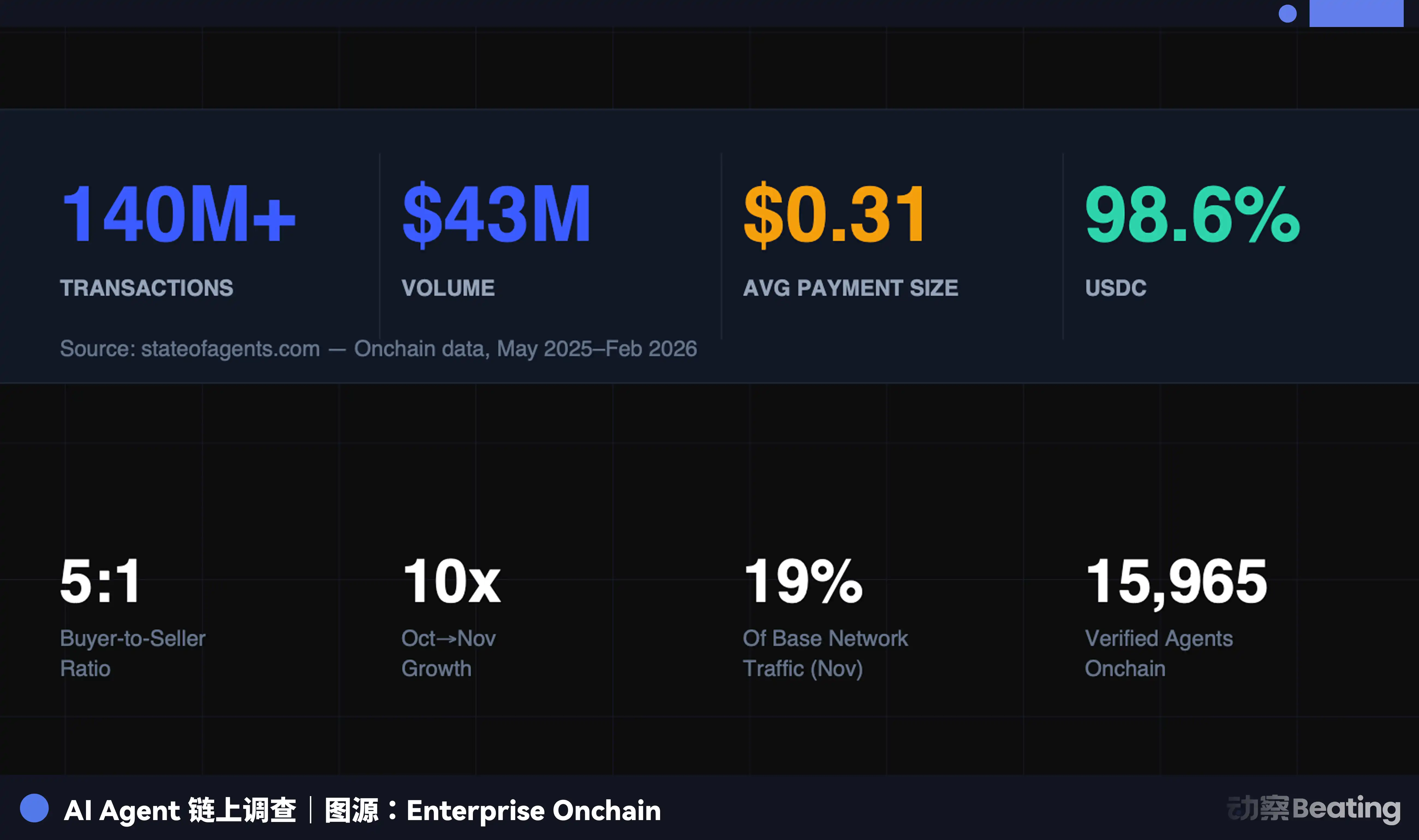
Let's look at the meaning of these numbers。
First, machines trade independently. 140 million payments without human intervention, bank approval, credit card certification. The process between the code and the code, between the agreement and the agreement, which used to require human signature, reconciliation and settlement, is now done autonomously by the machine。
SECOND, THE SINGLE AMOUNT IS EXTREMELY SMALL. THE AVERAGE TRANSACTION AMOUNT OF $0.31 MEANS THAT THE VAST MAJORITY OF THESE PAYMENTS ARE MICROPAYMENTS FOR API CALLS, COMPUTING, DATA ACCESS, ETC. UNDER TRADITIONAL PAYMENT SYSTEMS, SUCH TRANSACTIONS ARE SIMPLY NOT POSSIBLE, AND THE MINIMUM HANDLING COSTS OF ANY NETWORK EXCEED THE VALUE OF THE TRANSACTION ITSELF。
Third, costs are approaching zero. Complementing the x402 protocol, paying for the HTTP request directly embedded in the Circle Nanopayments reduced the individual transaction costs of the developer to zero by bringing together tens of thousands of petty payments under the chain and packing them on a regular basis。
Transactions between machines and machines, failure to close the account pages, failure to pay the gateway and lack of intermediaries are sources of concern。
Of course, zero costs are now only minimally paid for this particular scenario. Stable coins are not really free, and a small Stable currency transaction on the Internet could cost more than 20% of the transaction, and Stripe built Tempo to solve this problem。
At the consumer payment level, the card network continues to have the advantage of stabilizing currencies that cannot be replicated, uniform consumer protection, consistent user experience and the ability of the card to act as a flexible route at the bottom of the abstract。
But this does not change the nature of the worry, and zero costs are already a reality in the micro-paying scenario of inter-machine HF, and the gap is rapidly widening. Deloitte predicts that the global Agent market will reach $45 billion by 2030. This is a whole new world of transactions that opens a huge gap on the edge of traditional payments。
The Giant's Response: From Road Fees to Bridge Repair
In the face of zero-cost threats, conventional payment giants have different coping strategies, but share a bottom logic that controls the bridge between old and new systems, where fees are charged, since they cannot be charged in the micro-paying scene。
Visa's strategy is to absorb rather than confront. The USDC settlement is officially on line in the United States, and the encrypted and friendly banks Cross River Bank, Lead Bank and others are already in use, and Visa Direct supports the stabilization currency prefilling and direct payment。
In other words, you can use stable coins, but please take my pipe. Visa was also involved in the development of the MPP, which extended the protocol to the card payment scene, a typical move to join if it fails。
Mastercard spent $1.8 billion buying BVNK, the bridge between French and stabilization. BVNK supports currency stabilization in all mainstream block chain networks in over 130 countries, which is the most critical infrastructure of the AI Age payment era。
Mastercard's chief product officer, Jon Lambert, responded directly to the claim that the currency threat card business was stable, that it was not problematic and that the acquisition was intended to open up new areas such as remittances. But the deeper logic is that, when the volume of currency transactions increases at a fast pace, controlling the clearing bridge between the French currency and the stable currency is the throat that controls the flow of value。
Stripe's ambition is greatest. It owns its own block chain, Tempo, its own agreement, MPP, the platform that allows enterprises to issue their own stability coins and share the benefits of reserves, Open Insurance, which is the ultimate vertical integration。
The combination of Tempo + MPP + Open Insurance means that Stripe is no longer a payment processor, but is becoming an AI Agent-era infrastructure operator。

PayPal took a different path. The purchase of Cymbio was not intended to control the payment pipeline, but rather to control the distribution of the business catalogue. The core capacity of Cymbio is Store Synch, which allows a business to synchronize its product catalogue to multiple AI shopping surfaces, meaning that small and medium-sized businesses no longer need to fit each of the AI platforms。
When AI Agent took the place of humans to discover the goods, was it possible for the merchant's catalogue to be seen by AI as a matter of life or death? PayPal gambled in the age of Age Commerce and was found by Agen to be worth it。
An interesting middle-state is Ramp Agent Cards, which issues a virtual card to AI Agent, or Visa Card Track, but which, in essence, transforms the business spending card into an Agent wallet by authorizing each transaction dynamic and not exposing the real card information。
Whether this is a continuation of traditional payments or a stopgap approach to transition is not clear. If the dominant pattern of inter-machine transactions eventually leads to a stabilization of the original currency, then Agent Cards may be the last chance that traditional card networks will be needed in the new era。
How do we make money
Here is a question that has not been answered positively. On the zero-cost track, the transaction itself does not incur a handling fee. So, who's gonna make money
Circle's Nanopayments depend on infrastructure services, Stripe's Open Insurance on reserve revenue, and Mastercard's acquisition of BVNK was followed by a conversion between French and stabilization currency。
There is a common feature of the three types of fees, which move from the transaction itself to the conditions under which the transaction can take place. Essentially, it is closer to infrastructure rents rather than transaction taxes。
This is a fundamental shift in business models. Over the past 50 years, the moat of the payment network has been a network effect. The more businesses, the more consumers are willing to use them; the more consumers, the more businesses need access, and this flyer earns the right to pay for it on a scale。
In the world of inter-machine trade, the wheel is dead. Machines only need stable, programmable, low-cost settlements, and whoever can provide them is the new infrastructure provider。
It's not a big deal to pay the giants to survive. What really remains to be resolved is where does power go in a sector where power is maintained by a drafter, after the commission has become meaningless
